
Used EV vs Used Hybrid: Which Is the Smarter Buy?
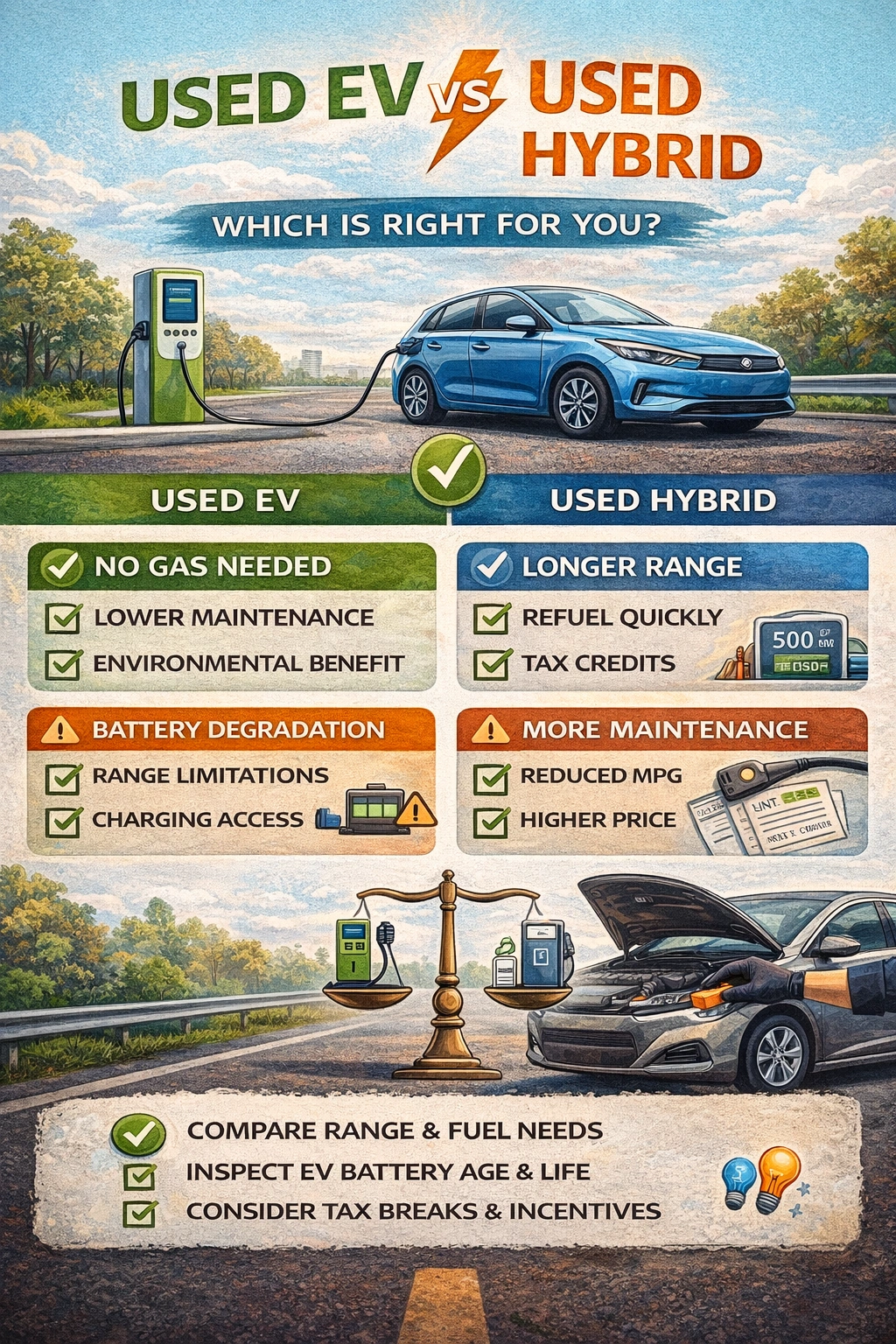
A used EV and a used hybrid solve different problems. Used EVs are 30–40% cheaper than new on comparable vehicles, perfect for drivers with home charging who stay under 250 miles per day, and cost $0.04–$0.05 per mile in electricity versus $0.11–$0.13 per mile in gasoline for equivalent hybrids. Used hybrids offer the lowest total cost of ownership in the 2–8 year old vehicle market, no charging infrastructure requirement, and proven 15–20 year battery longevity on Toyota and Honda platforms. The right choice depends on one factor: whether you have access to at-home charging (Level 1 is enough).
The decision tree in one question
Answer this first: can you plug a cable into a standard 120-volt outlet at home overnight? That is Level 1 charging. If yes, both EVs and hybrids are viable.
- No home charging access at all: used hybrid. Used EVs require reliance on public charging, which runs $0.35–$0.50/kWh versus $0.14/kWh at home. Public charging erases most of the EV cost advantage and adds routine friction.
- Level 1 (120V) available at home: either works. EV if you drive under 40 miles most days and can charge 10+ hours overnight; hybrid if your driving is less predictable.
- Level 2 (240V) available at home: EV is the strong value play. Faster home charging handles any commute pattern, and cost-per-mile is substantially lower than hybrid.
Purchase price: what is actually on the used market
Representative 2025 used-market listings (3–4 year old vehicles, 30,000–55,000 miles):
- 2021 Toyota RAV4 Prime (PHEV): $28,000–$36,000
- 2022 Toyota Prius (hybrid): $22,000–$28,000
- 2021 Honda CR-V Hybrid: $24,000–$29,000
- 2022 Tesla Model 3 Long Range: $26,000–$33,000
- 2022 Chevrolet Bolt EV: $17,000–$22,000
- 2021 Ford Mustang Mach-E: $25,000–$32,000
- 2021 Hyundai Ioniq 5: $27,000–$33,000
- 2022 Kia Niro EV: $22,000–$28,000
Used EVs depreciate faster than used hybrids — roughly 55–65% depreciation over 4 years on EVs versus 40–50% on Toyota and Honda hybrids. That is bad news for new-EV buyers but excellent for used-EV buyers. Model Y and Model 3 specifically have dropped $8,000–$14,000 faster than original owners expected, creating strong used-market value.
Cost per mile: the actual math
At 12,000 annual miles:
- Used EV (3.5 mi/kWh): 3,428 kWh × $0.14/kWh = $480/year in fuel
- Used hybrid (48 mpg): 250 gallons × $3.40/gallon = $850/year
- Used ICE equivalent (28 mpg): 428 gallons × $3.40 = $1,455/year
EV savings over hybrid: $370/year. Savings over ICE: $975/year. Over 5 years of ownership: $1,850 vs hybrid, $4,875 vs ICE.
Battery longevity: different failure modes
Both EVs and hybrids use lithium-ion (newer EVs) or nickel-metal hydride (older hybrids and some current ones) packs, but failure modes differ:
- EV battery: degrades gradually with age and use. Federal 8-year/100,000-mile warranty covers sub-70% capacity. Out-of-warranty pack replacement: $8,000–$18,000.
- Hybrid traction battery (Toyota/Honda): field data from the 2001–2015 Prius fleet shows typical lifespan of 15–20 years in moderate climates with cooling system maintained. Replacement from independent rebuilders (The Hybrid Shop, Greentec): $2,000–$3,500 for Prius, $2,500–$4,000 for Ford and Honda hybrids.
- PHEV battery: mid-size lithium pack covered by the same 8-year federal warranty. Smaller than pure EV (typically 10–18 kWh versus 60–100 kWh), so replacement cost is lower — $5,000–$9,000 typical.
Maintenance cost comparison
Pure EVs are the cheapest to maintain among all vehicle types by a wide margin:
- No oil changes (zero)
- No transmission fluid changes (direct-drive motors)
- Brake pad and rotor life typically 2–3× longer (regenerative braking)
- No spark plugs, belts, or exhaust components
- Battery coolant flush every 100,000–150,000 miles
- Cabin air filter and tire rotation only on regular intervals
Hybrids share some EV benefits (extended brake life) but retain most conventional maintenance (oil, coolant, transmission). Hybrid maintenance is typically 10–20% cheaper than an equivalent gasoline car, mostly through brake pad longevity.
AAA cost-of-ownership data (2024) shows lifetime maintenance per mile:
- Pure EV: $0.045/mile
- Hybrid: $0.065/mile
- Gasoline: $0.078/mile
When used hybrid wins
- No home charging: definitive for hybrid.
- Rural or road-warrior use: 600+ mile days or remote areas without charging infrastructure.
- Longest expected ownership (8+ years): Toyota and Honda hybrids outlast EVs on proven data. A 2015 Prius with proper maintenance is reliably at 200,000+ miles in 2025; equivalent-age first-gen EVs are hit or miss.
- Cold climates: EV range drops 20–35% at sub-zero temperatures; hybrids lose 5–10% fuel economy in the same conditions.
When used EV wins
- Daily driving under 40 miles: Level 1 charging handles it; huge cost-per-mile savings.
- Level 2 at home: best-case EV ownership; all cost advantages apply.
- Short expected ownership (3–5 years): the lowest annual operating cost while federal warranty still covers the battery.
- Urban with primarily highway commuting: EVs are at their most efficient (versus hybrids being most efficient in city stop-and-go).
PHEVs: a compromise worth considering
Plug-in hybrids (Toyota RAV4 Prime, Ford Escape PHEV, Hyundai Tucson PHEV, Kia Sorento PHEV) split the difference. For drivers with 25–40 miles typical daily range who also take occasional road trips:
- Electric-only range of 25–45 miles on a full charge
- Gasoline engine for longer trips (no range anxiety)
- Higher MSRP than pure hybrids, similar used-market depreciation to EVs
- Can qualify for federal tax credits on used-EV purchases in eligible states
A used 2021 Toyota RAV4 Prime at $32,000 is often the single best-engineered choice for households with one Level 1 or Level 2 home charger and mixed-use driving.
Frequently asked questions
Can I qualify for the federal used-EV tax credit?
The Used Clean Vehicle Credit (up to $4,000 or 30% of the sale price, whichever is less) applies to qualifying used EVs and PHEVs bought for under $25,000 from a licensed dealer, model year at least 2 years older than the purchase year, by a household with income under specific caps ($150,000 joint, $75,000 single in 2025). The credit cannot be claimed twice on the same vehicle.
How do I check a used EV’s battery health?
See the dedicated article on EV battery health for used cars. Briefly: ask for OBD-II diagnostic screenshots from the seller, bring a Bluetooth OBD dongle and brand-specific app to the test drive, or pay for a professional scan ($75–$150) at an EV-experienced shop. A State of Health (SoH) reading of 88%+ is acceptable for a 3–5 year old EV.
Is a used hybrid battery still under warranty?
Federal law requires 8 years/100,000 miles on hybrid traction battery from original in-service date. CARB states (California and 16 others) extend this to 10 years/150,000 miles. Confirm original in-service date via manufacturer or dealer records — a 2017 hybrid bought used in 2024 is out of the 8-year window.
What’s the safest used EV or hybrid brand to buy?
Toyota hybrid platforms (Prius, Camry Hybrid, Highlander Hybrid) and Honda hybrid platforms (Accord Hybrid, CR-V Hybrid) lead in documented reliability. Among EVs, Tesla Model 3/Model Y have the largest on-the-road fleet and the best parts-availability; Chevy Bolt has excellent reliability post-battery recall. Avoid early-production Nissan Leaf (2011–2013) in hot climates.
Is buying from a private seller risky on used EVs and hybrids?
It depends on the seller's documentation. Ask for complete service records (oil changes on hybrids, software update history on EVs), original manufacturer warranty transfer paperwork, and any battery-health reports. Private-sale CPO vehicles (sold by the dealer as certified) typically offer the best risk/value balance.