
EV Home Charging Costs Explained for Everyday Drivers
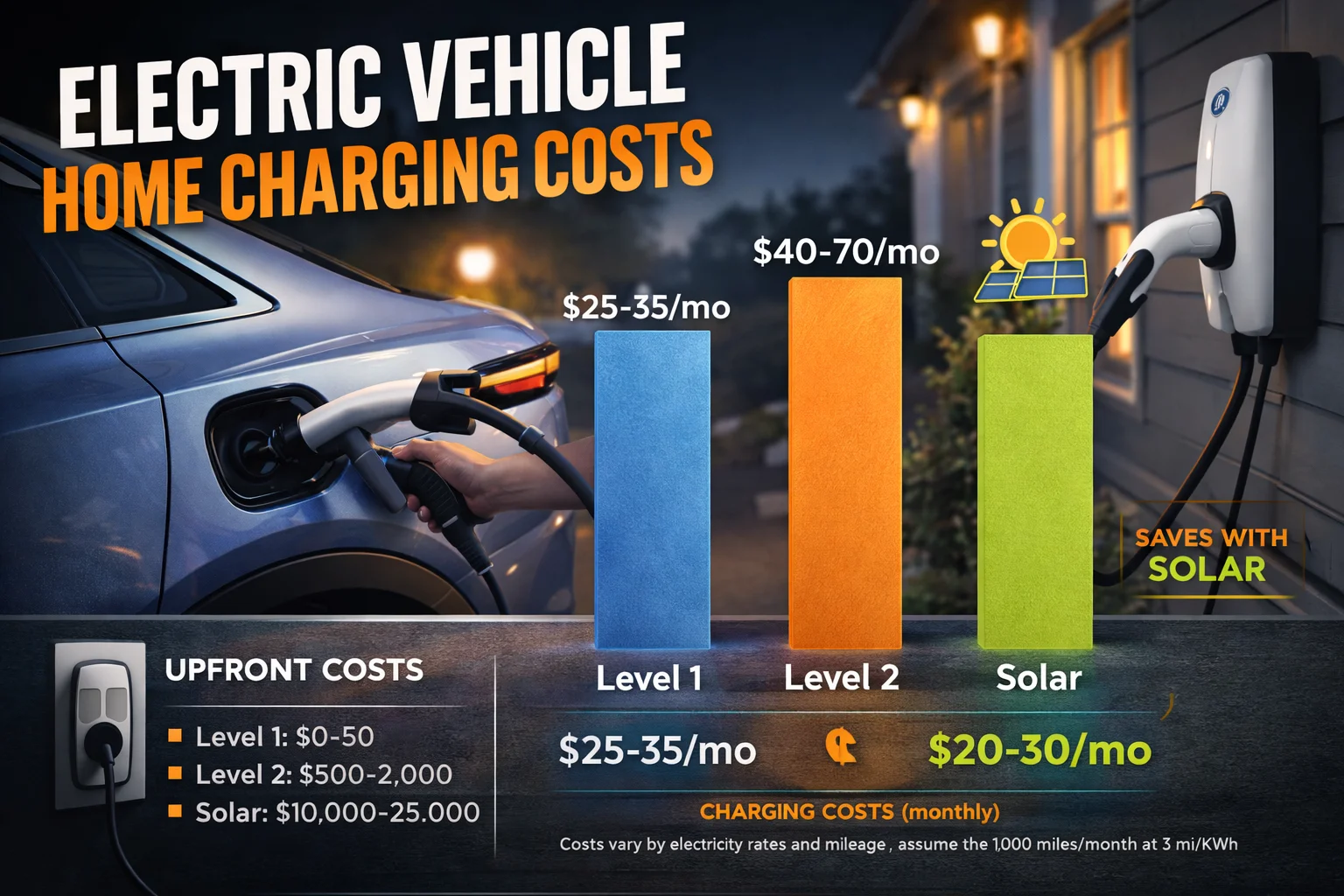
The typical U.S. EV driver spends $480–$720 per year on home electricity to drive 12,000 miles — roughly half the cost of gasoline for an equivalent 30-mpg car. Level 2 hardware plus installation runs $800–$2,500 before rebates, but the federal 30C tax credit (Inflation Reduction Act) returns 30% up to $1,000. Utility off-peak rates can cut the annual energy bill by another 30–50%. The full cost picture comes down to three variables: your kWh rate, your panel's spare capacity, and whether your utility offers a time-of-use EV rate.
Level 1 vs Level 2: the $0 option is real
Level 1 charging uses a standard 120-volt household outlet and the mobile cable that ships with most EVs. It adds 3–5 miles of range per hour, or roughly 40–50 miles overnight. For drivers who commute under 40 miles a day and park for 10+ hours, Level 1 works indefinitely — no hardware, no install.
Level 2 uses a 240-volt circuit (the same voltage as an electric dryer) and adds 25–40 miles of range per hour, fully replenishing most EVs in 6–10 hours. Practical thresholds to upgrade:
- Daily commute consistently exceeds 40–50 miles
- Your utility offers off-peak rates that require completing a full charge between ~11 pm and ~7 am
- Multiple EVs share one garage
- You drive a pickup or SUV EV with a battery pack over 100 kWh (F-150 Lightning, Rivian R1T, Silverado EV) — Level 1 can't keep up with heavy use
Installation: what actually drives the price
Level 2 installations quoted by licensed electricians in 2025 cluster in three tiers, based primarily on the distance from your electrical panel to the parking spot and whether your panel has spare amperage.
- Simple install ($400–$900 labor + $300–$700 hardware): panel within 15 feet of the parking spot, spare 40–50A breaker slot available, conduit run through finished garage ceiling or wall.
- Standard install ($900–$1,800 labor + hardware): panel 20–60 feet from the charger, requires trenching or attic run, permit pulled, inspection scheduled. This covers roughly 60% of U.S. homes built 1990–2015.
- Panel-upgrade install ($2,500–$5,500 total): needed when the main service panel is 100A or lower, is full, or is outdated (Federal Pacific, Zinsco, or knob-and-tube). The electrician upgrades to a 200A panel, which usually also requires a new service entrance from the utility.
A hidden expense: cities including Los Angeles, Chicago, and Seattle require an electrical permit ($75–$250) and post-install inspection. Skipping the permit saves nothing — if a home insurance claim later investigates the charger, an unpermitted install can void coverage.
The federal 30C tax credit and utility rebates
Under the Inflation Reduction Act of 2022, Section 30C of the Internal Revenue Code provides an Alternative Fuel Vehicle Refueling Property Credit covering 30% of residential charging equipment and installation cost, capped at $1,000 per charging port. The credit applies to installations completed through December 31, 2032, and is claimed on IRS Form 8911. Your home must be located in an eligible census tract (low-income or non-urban) — per 2024 IRS guidance, the eligibility map covers roughly two-thirds of U.S. residential addresses.
State and utility rebates stack on top. As of 2025:
- PG&E (California): $500 rebate via Pre-Owned EV rebate + additional for chargers
- Con Edison (NY): up to $500 via SmartCharge rewards over 12 months
- Xcel Energy (CO, MN): $500–$1,300 for qualifying Level 2 hardware
- Eversource (MA, CT): up to $700
- Duke Energy (NC, SC): $400 bill credit + off-peak rate enrollment
Check your exact utility's EV program page before purchasing hardware — many rebates require pre-approval of the specific charger model.
The energy math: what a kWh actually buys
Most modern EVs achieve 3–4 miles per kWh in real-world mixed driving (EPA combined efficiency figures verify this on fueleconomy.gov/" rel="nofollow noopener" target="_blank">FuelEconomy.gov). Working backwards:
- 12,000 miles ÷ 3.5 mi/kWh = 3,428 kWh annually
- At the U.S. average residential rate of $0.16/kWh (EIA, 2025): $548 per year
- On a time-of-use plan with $0.09 overnight: $308 per year
- In Hawaii ($0.42/kWh, the highest U.S. state): $1,440 per year
- In Washington state ($0.11/kWh): $377 per year
Compare that to a gasoline car: 30 mpg × 12,000 miles ÷ 30 = 400 gallons. At the 2025 U.S. average of $3.40 per gallon: $1,360 per year. The typical EV driver saves $600–$900 annually on fuel, with the largest savings in states with cheap electricity and the smallest (sometimes negative) in Hawaii, Connecticut, and California during peak hours.
Time-of-use: where most savings come from
Utilities price electricity by demand. Peak hours (typically 4–9 pm) can cost 2–3× more than overnight rates. Every major utility now offers an opt-in time-of-use (TOU) or EV-specific rate. A smart charger or the car's onboard scheduler starts the charge at the TOU trigger time and stops at peak onset.
A PG&E EV-2A rate (California, 2025) charges $0.31/kWh at peak and $0.24/kWh mid-peak but only $0.17/kWh off-peak. Scheduling charges for 11 pm to 7 am saves roughly 45% versus charging at arrival. On the same 3,428 kWh per year, that is approximately $480 saved.
Hardware picks: what to actually buy
Five chargers dominate the reliable Level 2 market as of 2025, based on Consumer Reports testing and warranty claim data from utility rebate programs:
- ChargePoint Home Flex ($599–$749): adjustable 16–50A output, UL listed for indoor and outdoor install, 3-year warranty, integrates with ChargePoint public network for public-charge tracking.
- Tesla Universal Wall Connector ($595–$650): now ships with both NACS and J1772 adapter, works with any EV, 48A output, WiFi scheduling.
- Wallbox Pulsar Plus ($649–$799): compact form factor, 40A, robust app, reliable in cold weather.
- Grizzl-E Classic ($399–$499): cheapest proven option, no app, rated in Consumer Reports as most reliable budget unit, 3-year warranty, 40A.
- Emporia EV Charger ($429–$529): strong value, energy monitoring, 48A, dealer rebate-friendly.
Hardwired vs plug-in: a hardwired charger on a 50A circuit supports 40A continuous output; a NEMA 14-50 plug limits the circuit to 80% (32A continuous). For frequent multi-EV charging, hardwire. For a renter or anyone who may move, plug-in is portable.
Frequently asked questions
Will my electric bill double with an EV?
Rarely. A typical household uses 900–1,100 kWh per month. An EV driven 12,000 miles adds ~285 kWh per month, a 25–30% bill increase before TOU savings. After enrolling in an off-peak rate, the net impact is often 10–15%.
Do I need a 200-amp panel to install a Level 2 charger?
Not always. A 100A panel can host a 30A EV circuit if the calculated load (per NEC Article 220) leaves headroom. An electrician performs a load calculation and issues a recommendation. If your panel is 60A or 100A and full, a panel upgrade is typically required regardless of EV charger size.
Is solar worth adding at the same time?
Payback depends entirely on your kWh rate and solar insolation. In California, Texas, and Arizona with $0.25+/kWh rates, pairing a 5–7 kW solar system with an EV charger typically reaches payback in 8–11 years. In Washington, Idaho, or Kentucky with sub-$0.12/kWh rates, solar payback exceeds 20 years and rarely pencils out for EV charging alone.
Does frequent home charging hurt battery life?
No. Level 2 home charging is the gentlest routine for lithium-ion battery longevity. What accelerates degradation is frequent DC fast charging to 100% (especially in heat) and sustained full-battery storage above 90% state of charge. Set your charge limit to 80–90% for daily use, and top to 100% only before a long trip.
Can I use a regular 120V outlet long-term without damage?
Yes, provided the outlet and wiring are in good condition. The concern with Level 1 is that old or corroded outlets heat up under sustained 12A draw. Have an electrician inspect the specific outlet you plan to use for eight-hour nightly sessions. Dedicated 15A or 20A circuits are preferred; shared household circuits can trip breakers if anything else draws significant current.