
How to Judge EV Battery Health on a Used Electric Car
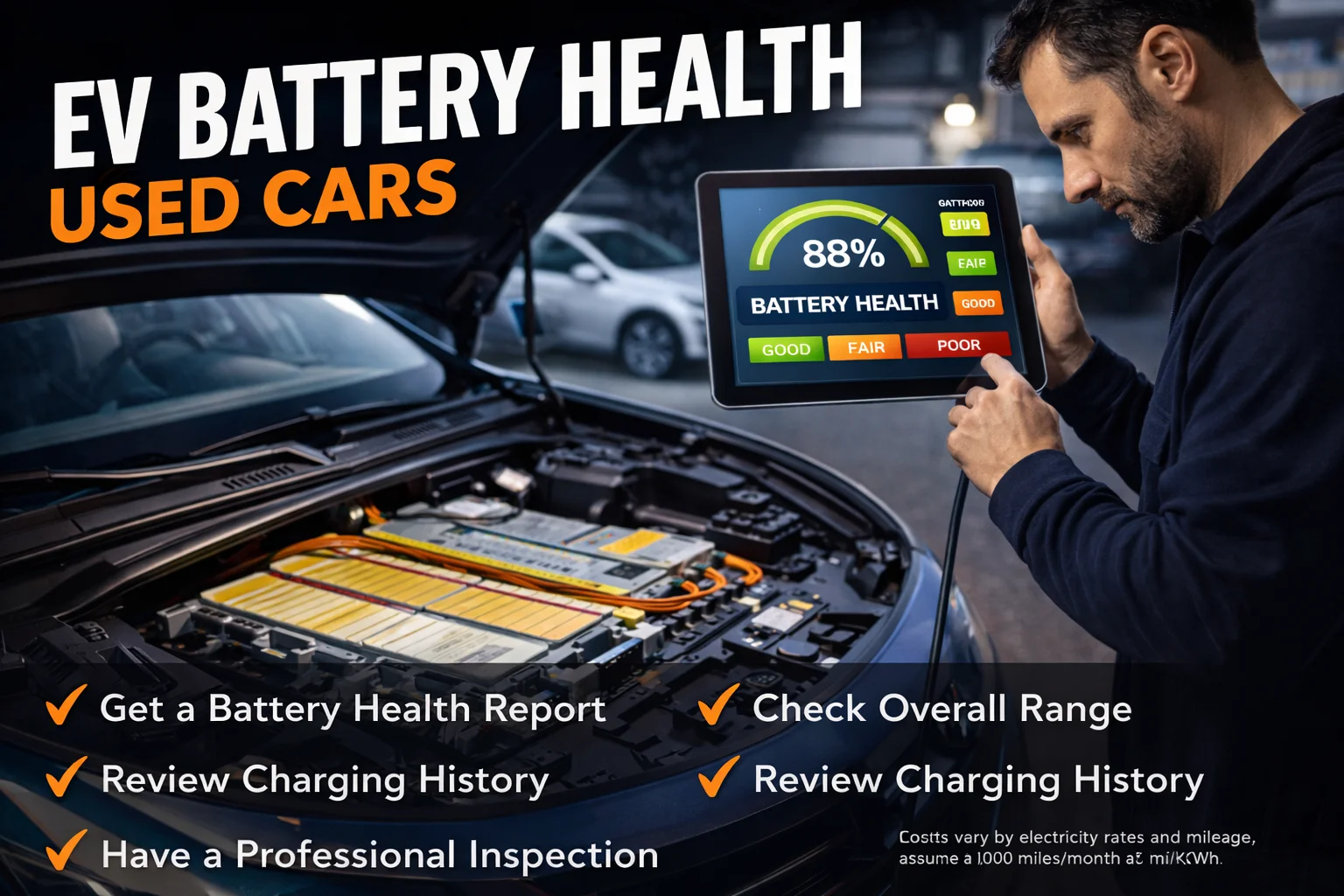
Battery state-of-health (SoH) is the single most important spec on a used EV, and manufacturers make it hard to see. The three ways to get a real SoH reading: ask the seller to pull it from the onboard diagnostic app (Tesla, Polestar, Rivian, Ford all display it to owners), bring an OBD-II dongle with an EV-specific app (LeafSpy, TeslaBMS, EVNotify) to the test drive, or pay for a professional SoH scan at a brand-experienced shop ($75–$150). A 2021 EV with 90%+ SoH and 30,000 miles is a strong buy; the same vehicle at 82% SoH is a warning — and the federal 8-year battery warranty from in-service date protects you on any covered replacement.
Why SoH matters more than mileage
Traditional used-car shoppers focus on mileage because engine and transmission wear track with miles. EV batteries degrade on a different curve: partially driven by miles, but also driven by calendar age, DC fast-charge frequency, ambient temperature exposure, and average state-of-charge history.
Geotab and Recurrent — two independent EV data aggregators — both published 2024 studies showing average EV battery degradation rates of 1.8–2.3% per year across the fleet. By year 5, a typical EV has lost 9–12% of original usable capacity. Outliers exist in both directions: some vehicles lose under 5%, some hit 18–20% within 5 years.
A 2020 Tesla Model 3 with 70,000 miles and 94% SoH is in much better shape than the same vehicle with 40,000 miles and 84% SoH — even though the higher-mileage car looks “worse” on paper.
How to get an SoH reading
Three methods, in rough order of accuracy:
- OEM onboard diagnostic: most accurate, uses the battery management system's own measurements. Available on Tesla (Service Mode, or the third-party app TeslaFi), Ford F-150 Lightning and Mustang Mach-E (FordPass shows range history), Rivian (manufacturer service), Polestar (Polestar App). Ask the seller for a screenshot.
- OBD-II with EV app: LeafSpy (Nissan Leaf), Torque Pro with custom PIDs, EVNotify, TeslaBMS (Tesla). Requires a Bluetooth OBD dongle ($20–$50) and 10–20 minutes at the test drive. Available for most mainstream EVs.
- Professional SoH scan: independent shops specializing in EVs (Tesla-focused: Rich Rebuilds, EV Clinic; multi-brand: Electrified Garage, Evolution Auto). Cost $75–$150, produces a detailed cell-level report.
- Third-party service: Recurrent (recurrentauto.com) offers free SoH reports on supported vehicles, mostly by scraping public charging network data. Useful as corroboration but less authoritative than a direct battery scan.
What SoH numbers actually mean
- 95–100% SoH: nearly new condition. Expected range within 2–3% of EPA published. Strong buy signal.
- 88–94% SoH: normal for a 3–5 year old EV. Expect 5–10% range reduction versus EPA. Acceptable; price negotiation should reflect this.
- 80–87% SoH: below-average. Either high DC fast-charge use, extreme climate exposure, or manufacturing outlier. Inspect further or walk away unless priced to reflect the degradation.
- Under 80% SoH: federal 8/100,000 EV battery warranty typically triggers a replacement or module-level refresh at this threshold. A used EV in this range may be worth buying specifically if it still has warranty coverage.
Federal warranty: the safety net
Under U.S. federal regulation (and California's CARB ZEV regulations in 17 states), all EVs sold new come with a minimum 8-year or 100,000-mile battery warranty from date of first delivery, covering replacement if capacity falls below 70% of original (some manufacturers use 66%, and Tesla pre-2020 used 70% or 80% depending on model).
This warranty is transferable on every major brand sold in the U.S., which means used EV buyers retain the balance. A used 2020 EV bought in 2025 still has 3 years of federal battery warranty from original in-service date. Confirm the transfer by checking dealer records or calling the manufacturer with the VIN.
Some manufacturers offer extended coverage:
- Hyundai, Kia, Genesis: 10 years/100,000 miles on battery
- Nissan Leaf (2013–2015 models): 8/100,000 plus capacity coverage
- Lucid Air: 10-year battery warranty
- Toyota (bZ4X, Lexus RZ): 10-year battery warranty with strict maintenance documentation requirements
Charging history: DC fast-charge frequency matters
Not all 60,000-mile EVs are equal. One driven by a road-warrior using DC fast charging weekly in hot climates degrades measurably more than one charged mostly at Level 2 home charging at 50–80% state of charge.
Some manufacturers track this in service records:
- Tesla: service records show total DC fast-charge events
- Ford: FordPass Connected Vehicle Data shows charging history
- Hyundai/Kia: dealer service records occasionally include charging event counts
Ask the seller: "How often did you use DC fast charging?" A daily-driver with exclusively Level 2 home charging is the lowest-wear scenario. A road-trip vehicle that used DC fast charging 200+ times is higher wear even at equivalent mileage.
Vehicles with specific known battery issues
- 2019–2020 Hyundai Kona Electric and Kia Soul EV/Niro EV: recall on LG Chem batteries. Affected VINs should have had pack replacement. Verify with the manufacturer.
- 2020–2022 Chevrolet Bolt EV and Bolt EUV: LG Chem battery recall, all affected units should have been replaced with updated cells carrying an extended 8-year/100,000-mile warranty from replacement date — often better than the original warranty.
- 2011–2012 Nissan Leaf (original): early LG Chem chemistry shows faster degradation in hot climates. Excellent city commuter below 50,000 miles; higher-risk purchase beyond that.
- 2013–2015 Tesla Model S 60 and 85: variable battery condition depending on charging history; pull SoH before purchase.
Price premium for verified SoH
Recurrent's 2024 used-EV pricing analysis showed listings with verified SoH reports sold for an average $1,200–$2,400 more than comparable listings without, demonstrating clear consumer willingness to pay for transparency. As a buyer, you can use this in reverse: request SoH data from the seller and negotiate harder when they refuse or cannot provide it.
Frequently asked questions
At what SoH should I walk away from a used EV?
Below 80% on a vehicle with expired or near-expired federal battery warranty. At 80% with warranty still in force (in-service date less than 8 years ago and under 100,000 miles), it may be worth buying specifically because the battery likely qualifies for replacement soon.
Does rapid charging kill EV batteries?
It accelerates degradation but does not catastrophically damage modern lithium packs. Tesla, Porsche, and Lucid internal data suggest 100 DC fast-charge sessions per year cost 1–2% additional annual capacity loss. Avoid daily fast-charging when Level 2 is available.
How long do EV batteries actually last?
Current industry projection based on accelerated aging studies and the oldest real-world vehicles: 15–20 years or 300,000–500,000 miles to 70% capacity. The 2013 Tesla Model S fleet is the most-watched long-term dataset; a substantial percentage of 2013–2014 units are still in service in 2025 with 80%+ SoH.
What’s the difference between range and SoH?
SoH is the battery's energy capacity relative to new. Range is how many miles that energy produces, which also depends on efficiency (affected by tire age, weight, weather). A battery at 90% SoH driven in the cold will show a range below 90% of EPA; the battery itself is still at 90% capacity, the car just uses more of it per mile.
Can a used-EV battery be replaced outside the warranty?
Yes. Pack replacement costs currently range $8,000–$18,000 parts-and-labor depending on vehicle, usually at dealer. Independent rebuilders (Gruber Motor, Sun Country Highway) offer refurbished packs at $3,500–$9,000 with module-level rebuilding on Tesla, Leaf, and Bolt platforms. Either option is cheaper than replacing the vehicle in most cases.