
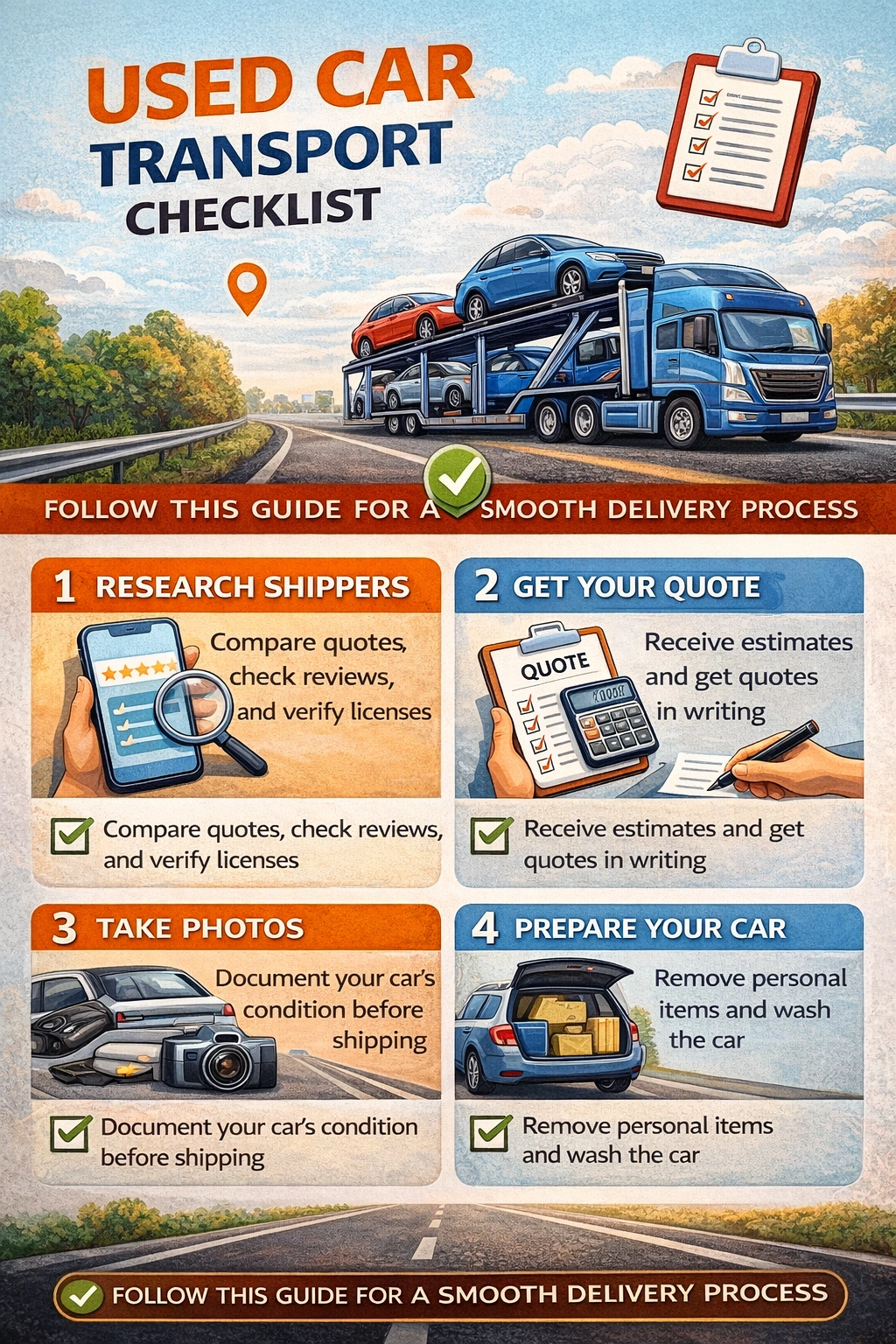
Used Car Transport Checklist Before You Book a Carrier
Before wiring a deposit to any auto transport company, verify three things: the carrier's active Motor Carrier (MC) number on the FMCSA SAFER system, the minimum $750,000 cargo insurance certificate required under federal 49 CFR 387.303 for interstate carriers, and a written bill of lading that documents vehicle condition at pickup and delivery. Skip any of these and a damage claim becomes an expensive civil lawsuit instead of an insurance payout.
Broker vs carrier: know who you are paying
Most online transport quotes come from brokers — companies licensed to arrange transportation but who do not own trucks. Brokers post your load to a central load board (Central Dispatch is the dominant one) where licensed motor carriers bid to haul it. Your contract is typically with the broker, but the truck, driver, and insurance belong to the carrier.
Both are legitimate. Problems arise when a customer does not know which they are dealing with. Ask directly: "Are you a broker or a carrier?" A broker should provide the MC number of the actual carrier as soon as the load is assigned. Refusing to disclose the carrier until pickup day is a red flag that appears in the majority of transport complaints filed with the Better Business Bureau's auto-shipping category.
The federal paperwork that actually matters
Every interstate auto transport carrier must hold, at minimum, a Motor Carrier Authority issued by the U.S. Federal Motor Carrier Safety Administration (FMCSA). You can verify any carrier's status in under 60 seconds by entering their MC or USDOT number at safer.fmcsa.dot.gov.
What to check on the SAFER record:
- Operating status: must show "AUTHORIZED FOR Property." "Not Authorized" or "Out of Service" is a dealbreaker.
- Insurance on file: confirms the carrier has filed proof of the required $750,000 cargo coverage (higher for hazardous loads) and public liability coverage of $1,000,000 for non-hazmat under 49 CFR 387.
- Safety rating and out-of-service rate: a driver or vehicle out-of-service rate above the national average signals frequent inspection failures. FMCSA publishes current thresholds annually in its SMS scoring methodology.
- Crash history: recordable crashes in the past 24 months are listed.
The bill of lading: your damage claim hinges on it
The bill of lading (BOL) is the legal contract between you and the carrier. The driver fills one out at pickup and another at delivery. Your signature on these documents is the only record the insurance adjuster will accept when evaluating a claim.
Before the driver drives away at pickup:
- Walk the vehicle with the driver. Note every existing scratch, chip, dent, and wheel scuff directly on the BOL diagram.
- Take 20–30 time-stamped photos of every exterior panel, all four wheels and tire sidewalls, the windshield, the roof, the undercarriage if visible, and the interior including the odometer reading.
- Never sign a BOL that says "clean" or "no exceptions" when you have observed pre-existing damage. That single signature forfeits your right to recover for pre-existing damage that worsens during transit.
At delivery, repeat the same inspection in daylight. If the vehicle arrives at night, wait until morning if possible, or note on the BOL "delivered at night, unable to fully inspect" before signing.
Open vs enclosed: when the price premium pays off
Open-carrier transport (the two-level truck that hauls 8–10 vehicles on a visible rack) is how roughly 90% of new and used cars move in North America. Typical cost for coast-to-coast shipment of a standard sedan in 2025 was $1,200–$1,600.
Enclosed transport runs $1,800–$2,800 for the same route and adds meaningful protection against road debris, weather, and theft. The economics only work when the vehicle value, rarity, or restoration investment exceeds roughly $50,000 — or when the car cannot realistically be repainted if damaged. For a 2019 Honda CR-V with 65,000 miles, open transport is the correct answer. For a low-mileage E30 M3 or a just-finished restoration, enclosed is required.
Prepping the vehicle for pickup
- Fuel level at 1/4 tank or less. Carriers are bound by DOT weight limits per axle; a full tank on every vehicle pushes a full rack over legal weight. A few companies refuse pickup if the tank exceeds 1/4.
- Battery charged and tires properly inflated. A vehicle that will not start or roll requires winching, which adds $100–$300 in fees and often delays the schedule.
- Remove personal items. Federal interstate carrier insurance typically does not cover items left in the vehicle. Some carriers will tolerate up to 100 pounds in the trunk if declared on the BOL; most prefer the car to be empty.
- Disable aftermarket alarms that could drain the battery if triggered in transit.
- Fold in side mirrors and retract antennas. Trapped mirrors are the single most common "cosmetic" damage claim on open transport.
- Document the mileage. Photograph the odometer immediately before pickup. Unexpected mileage additions signal unauthorized test drives.
Payment structure and common pricing traps
A legitimate transporter typically collects a broker or reservation fee at dispatch (often $100–$200) and the balance on delivery in cash, cashier's check, or certified funds. Be cautious when asked to pre-pay 100% by credit card before a carrier is assigned — that is the structure most associated with no-show and bait-and-switch complaints at the FMCSA's National Consumer Complaint Database.
Quotes below the regional market rate are a leading indicator of a broker who will not actually find a carrier at that price. When pickup day arrives and no carrier has accepted the load, the broker calls to "update the rate" $200–$500 higher. Decline lowball quotes; accept quotes within $50–$150 of the regional average published on Central Dispatch's public pricing snapshots.
Frequently asked questions
How early should I book vehicle transport?
Book 1–3 weeks ahead for popular routes (California, Texas, Florida, Northeast corridor). For rural pickups or off-peak routes, 3–5 weeks is safer. Same-week bookings usually trigger a 15–25% premium because the load must price high enough to attract a carrier already en route.
Is the carrier's insurance actually enough to cover my car?
The federal minimum is $750,000 in cargo coverage per truck, not per vehicle. A truck carrying 10 vehicles at a combined $400,000 is adequately covered. For high-value vehicles exceeding $100,000, confirm the carrier's actual per-vehicle limit in writing and consider supplemental transit insurance through companies like Reliance Carrier or Allied Insurance.
Can I track the carrier during transit?
Some national carriers offer GPS tracking via an app; most independents do not. What you should expect is a phone number for the driver and a promised window for pickup and delivery. Call for status every 24–48 hours if needed. Federal hours-of-service rules limit drivers to 11 hours of driving per 14-hour workday, which is why coast-to-coast transit typically takes 7–10 days.
What do I do if the car arrives damaged?
Note every new damage item on the BOL at delivery, take timestamped photos before signing, and refuse to sign a "clean" delivery receipt. File a written claim with the carrier within the window stated in the BOL (typically 9 months under federal rules in 49 CFR 370). If the carrier denies or ignores the claim, escalate to the FMCSA complaint line and, if the damage exceeds insurance coverage, file in small claims or civil court.
Is door-to-door really door-to-door?
Rarely. Full-size auto carriers (roughly 75 feet long with a ramp deployed) cannot navigate most residential streets, tight cul-de-sacs, or low-clearance driveways. "Door-to-door" in practice means the driver will meet you at the closest accessible location — often a large parking lot 2–5 miles from your address. Confirm this expectation at booking rather than at delivery.