
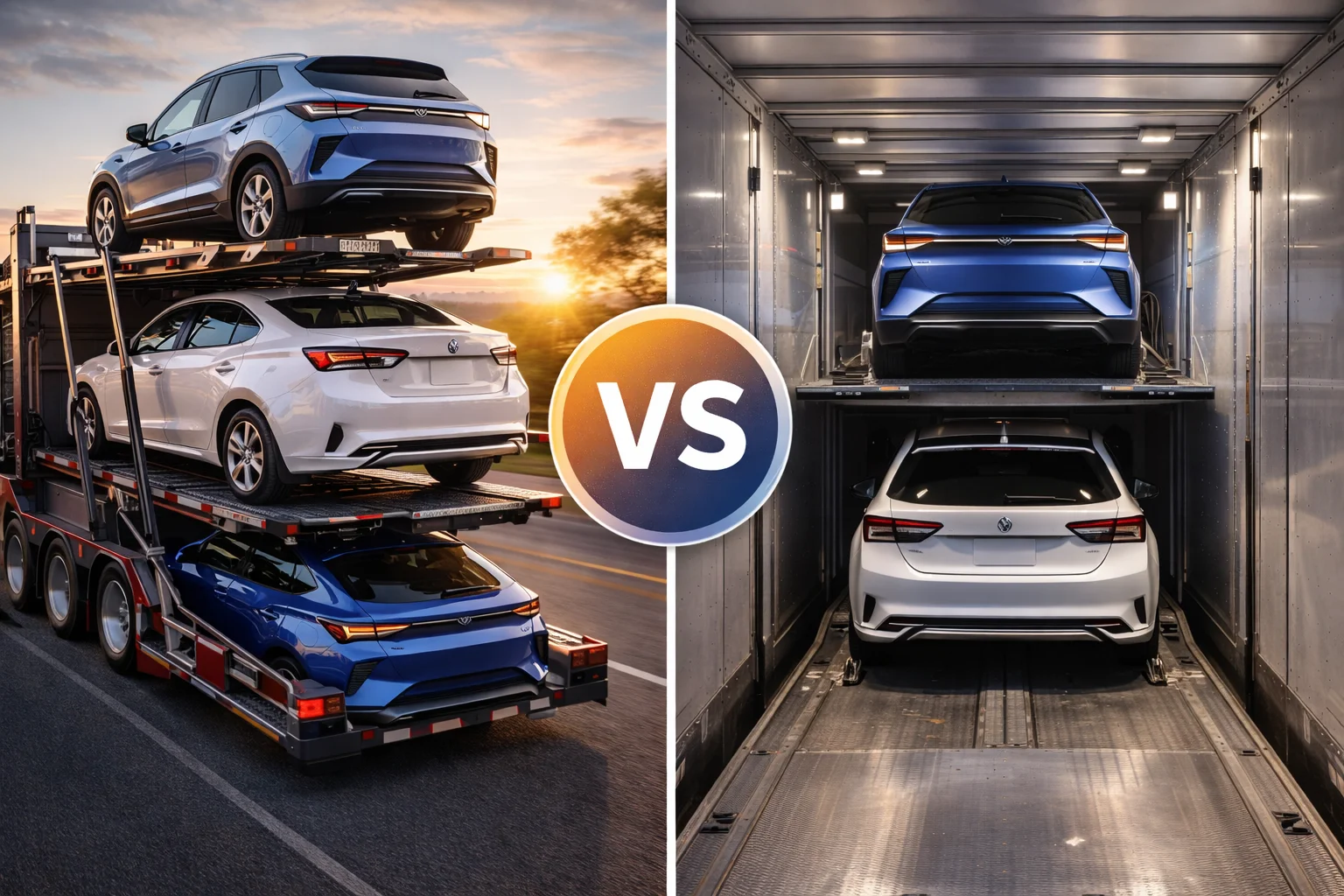
Open vs Enclosed Car Shipping: Which One Is Worth It?
Open transport moves 90%+ of all U.S. auto shipping and runs $1,200–$1,600 coast-to-coast on a standard sedan. Enclosed transport costs $1,800–$2,800 for the same route and makes sense for three specific scenarios: vehicles worth over $50,000, vehicles with freshly applied paint or PPF, or vehicles that cannot be repainted to original factory specification if damaged. For everything else — daily drivers, used cars, most family vehicles — open transport is the correct choice, and paying for enclosed is almost always spending money that could go toward pre-trip ceramic coating and post-transit detail instead.
What each method actually looks like
Open transport is the recognizable two-level truck carrying 8–10 vehicles on a visible metal rack. Vehicles are strapped at the wheel hubs with nylon soft straps (the modern standard) or with tire basket straps. They are fully exposed to weather, road debris from the highway, and other vehicles on the same rack — drips from engines above, trim edges, bumper corners. A typical load is mixed with rental returns, dealer deliveries, and private shipments.
Enclosed transport uses a fully walled trailer, typically carrying 4–6 vehicles behind hydraulic lift gates rather than ramps. Vehicles are lifted into position, strapped at the frame rather than the wheels, and protected from UV, rain, salt, and road debris. The trailer is climate-controlled in the best operators' rigs and typically includes interior tie-down points, soft bumpers, and security.
Price and route spread in 2025
Based on current averages from the Central Dispatch load board and shipper surveys:
- Short haul (under 500 miles): open $500–$750, enclosed $750–$1,100. Premium spread: $250–$350.
- Mid-distance (500–1,500 miles): open $800–$1,200, enclosed $1,200–$1,900. Premium: $400–$700.
- Long haul (1,500–3,000 miles): open $1,200–$1,700, enclosed $1,800–$2,800. Premium: $600–$1,100.
- Peak season (May, June, September, October): both services run 10–20% higher. Winter routes north-to-south spike enclosed premiums because snowbirds move high-value vehicles.
When enclosed transport is the right call
Three clear cases:
- Vehicle value over $50,000: the premium is 2–4% of vehicle value, and any repair involving color matching, multi-stage paint, or aluminum body panels typically costs 3–8% of vehicle value. Risk math favors enclosed.
- Just-finished restoration or paintwork: fresh paint takes 30–60 days to fully cure and is vulnerable to bug acid, sap, and airborne debris during that window. Open transport puts freshly painted cars through every weather condition between pickup and delivery.
- Rare or irreplaceable trim: classic cars, factory race cars, heritage metal whose trim and chrome cannot be reproduced. The cost of losing a piece of bright-work during transit exceeds any reasonable savings on open shipment.
When open transport is fine
Most standard transport use cases. Open transport has a documented damage rate of roughly 1–2% per load according to Central Dispatch's published industry data, and most incidents are minor (paint chips from road debris, a scuffed wheel, mirror damage). All are typically covered by the carrier's $750,000 federal minimum cargo insurance.
The specific vehicles where open is usually right:
- New and recent-model used cars without special finishes
- Fleet and dealer vehicles
- College student cross-country relocations
- Relocation moves of daily drivers in the $15k–$45k range
- EVs and hybrids that are not high-performance variants
- Trucks and SUVs that live outdoors anyway
What enclosed transport does NOT guarantee
Enclosed transport is sold with a halo of perfect protection that does not fully match reality. Specifically:
- Enclosed carriers still strap at the wheels or frame. Improper strap placement can chip wheels, scratch undercarriage coating, or distort air-suspension components on vehicles with adjustable ride height.
- Dust accumulates inside enclosed trailers. Multi-day transit still deposits fine particulate on any horizontal surface.
- Insurance coverage caps may not be higher than open carriers. Check the declared per-vehicle limit in the carrier's certificate, not just the total cargo policy face value.
- Handling at pickup and delivery is where most damage happens. A technically-flawless enclosed truck with a careless driver winching a car up a ramp can damage a vehicle exactly as badly as an open carrier.
The hidden questions that matter more than open vs enclosed
Two questions distinguish competent carriers from the rest, regardless of open or enclosed:
- "How many vehicles do you carry?" Smaller loads (4–6 vehicles) handle faster and have fewer layover days. Full 9–10 car open carriers take longer to stage, load, and deliver.
- "Do you use soft straps or hard chains?" Hard chain tie-downs at the frame can stress modern unibody vehicles — prefer soft straps at the wheel hubs.
Real-world alternative: pay for ceramic plus open
A $1,000 decision between open ($1,200) and enclosed ($2,200) covers the cost of a mid-tier ceramic coating ($800–$1,200 at most shops) applied before shipment. Ceramic coating reduces acid etching from bugs and bird droppings, makes contaminants easier to wash off post-transit, and lasts 3–5 years after the trip. For shippers torn between upgrading to enclosed and saving on the haul, putting the spread into long-term paint protection is often the smarter choice.
Frequently asked questions
How much more does enclosed transport actually cost on a typical route?
$400–$1,100 more than open transport, depending on distance. On a 2,000-mile coast-to-coast shipment, expect to pay roughly $600–$900 in premium.
Is enclosed transport faster than open?
Usually yes — 2–4 days faster coast-to-coast because enclosed carriers operate dedicated point-to-point routes rather than the multi-stop zig-zag typical of open carriers filling 9–10 vehicle loads. For time-sensitive shipments this is worth considering even on lower-value vehicles.
Does my insurance company prefer enclosed transport?
Most auto insurers do not differentiate for standard personal vehicles. For collector cars valued over $75,000 on an Agreed Value policy (Hagerty, Grundy, Chubb), the insurer may require enclosed transport — check the policy before booking.
Can I ship a motorcycle in enclosed transport?
Yes, and for motorcycles the premium over open shipping is smaller and the case for enclosed is stronger. Motorcycles lack the body panels to absorb minor impacts that car panels shrug off. Most motorcycle shippers default to enclosed, and the cost spread is typically only $200–$400 on mid-distance routes.
Is “soft-sided” enclosed transport the same as hard-sided?
No. Soft-sided enclosed uses canvas or polymer curtain walls rather than rigid aluminum or fiberglass. It blocks direct weather but provides less debris and temperature protection than hard-sided. For most shipping purposes soft-sided is adequate; for museum pieces and concours vehicles, confirm hard-sided at booking.