
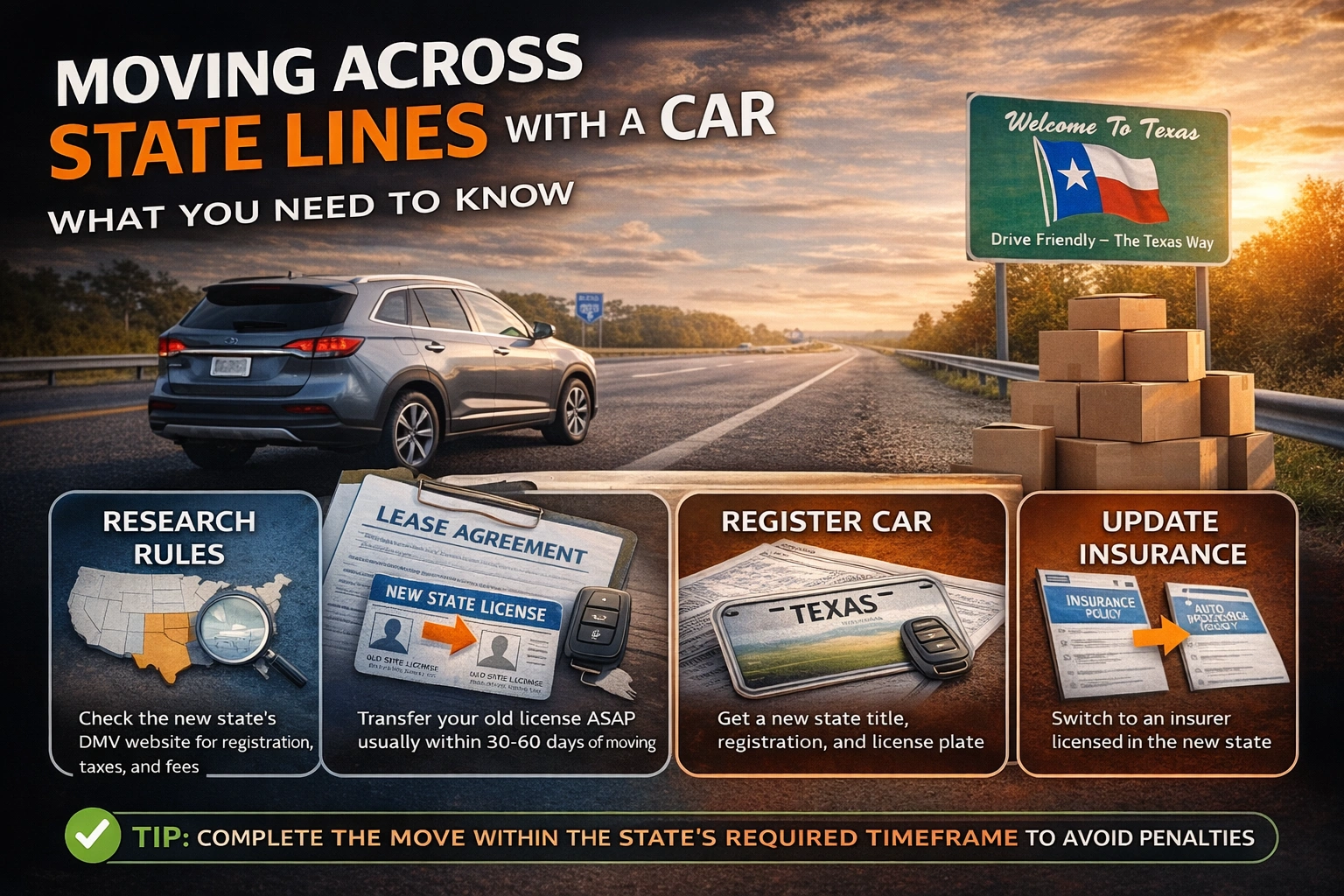
Moving Across State Lines With a Car: Plan the Smoothest Route
An interstate vehicle move has five components that must be handled in the right order: title transfer at the new state’s DMV within 30–90 days (varies by state), registration in the new state, proof of emissions inspection if required, updated insurance policy to the new address, and a new driver’s license. Miss any of these and you expose yourself to traffic citations enforced as ‘non-resident registration’ violations ($100–$500 fines), insurance gaps that void coverage on a claim, and federal automated license-plate-reader systems that flag out-of-state plates as potentially fraudulent after the grace period expires.
The 30-to-90-day clock
Every state sets a grace period for new residents to transfer their driver's license, vehicle title, and registration. Common windows:
- 30 days: California, New York, Massachusetts, Texas, New Jersey, Washington
- 60 days: Florida, Illinois, Colorado, Arizona, Georgia
- 90 days: Pennsylvania, Virginia, North Carolina, Michigan
The clock starts on the day you establish residency — typically defined as the day you take a job, register to vote, enroll children in school, or sign a lease of 6+ months. Carrying a prior state's driver license beyond the grace period can be cited as fraud in several states, not just a civil infraction.
Step 1: Title transfer
If your vehicle title is paid off, the new state's DMV accepts the prior-state title directly, issues a new title, and mails it (or, in some states, holds it if the lender is still on title). Required documents typically include:
- Original out-of-state title (not a copy)
- Completed title transfer application (specific form varies by state)
- Proof of identification (driver's license, passport)
- Proof of residency (lease or utility bill at new address)
- Vehicle Identification Number (VIN) verification — some states require a physical VIN inspection by a DMV agent or law enforcement officer before the title transfers
- Current odometer reading (federally required on any title transfer)
- Title transfer fee ($20–$165 by state)
If your vehicle has an active lien, the lender holds the title. You will need the lender's cooperation:
- Contact the lender and request a “lien notation request” to the new state
- Some states (California, Texas) accept electronic lien transfer without the paper title
- Other states require the lender to mail the title to the DMV for processing
- Allow 3–6 weeks for completion
Step 2: Registration
Registration is typically filed simultaneously with title transfer. Additional requirements often include:
- Emissions inspection (required in most states; 15–20 jurisdictions exempt diesel or EV vehicles or older model years)
- Safety inspection (required in 16 states including Pennsylvania, Virginia, New York, Massachusetts)
- Insurance verification — proof of liability coverage meeting the new state's minimums
- Registration fee — ranges $25–$350, often tied to vehicle value, weight, or age
- License plate fee — in most states new plates are issued; in a few (California, Texas) plate is transferable within the state
Step 3: Insurance update
Update your auto policy within 30 days of moving. Key considerations:
- Premium recalculation: your premium changes based on the new zip code, even if everything else is identical. Moving from Ohio to California can raise premiums 40–80% for the same vehicle and driver.
- Coverage minimums: state minimums vary widely. A policy meeting Florida's minimum ($10,000/$20,000 liability) would not meet Virginia's ($25,000/$50,000). Upgrade limits before crossing a border.
- State-specific coverage requirements: 12 states require PIP (personal injury protection), including Florida, Michigan, New York, Massachusetts. Uninsured motorist coverage is mandatory in 22 states.
- Multi-state carriers: GEICO, State Farm, Progressive, and Allstate all operate nationally and handle address changes simply. Regional carriers (Erie, Farm Bureau) may not offer coverage in your new state — requiring a new policy entirely.
Step 4: Driver's license
Same grace period as vehicle registration (30–90 days). Required documents typically:
- Out-of-state driver's license to surrender
- Proof of identity (original birth certificate or passport)
- Social Security card or other SSN proof
- Two proofs of state residency (utility bill, bank statement, lease agreement, pay stub at new address)
- Payment of license fee ($20–$90)
- Written test: waived in most states for out-of-state transfers with valid licenses
- Road test: rarely required for valid license transfers, but can be at DMV discretion in some states
- Vision test: required
If you are transferring a commercial driver's license (CDL), medical certification documentation and knowledge test may be required depending on endorsement class.
Step 5: Address updates across every record
Beyond the five major transfers above, the following records must be updated to avoid service interruptions:
- Voter registration
- USPS mail forwarding (online, $1 verification fee, 12 months forwarding)
- IRS address change (Form 8822)
- Bank accounts, credit cards, investment accounts
- Health insurance and medical records
- Subscriptions and professional memberships
- Parking permits (if moving to a city requiring residential permits)
Moving the vehicle itself
Three main options for moving a vehicle across state lines:
- Drive it: no transport cost, 2–4 days coast-to-coast. Adds 2,500–3,000 miles to the vehicle. Useful if you are moving one vehicle and have flexibility on schedule.
- Open transport: $1,000–$1,600 coast-to-coast on a sedan, $1,200–$2,000 on an SUV. 7–10 days transit. Best for most non-luxury vehicle moves.
- Enclosed transport: $1,800–$2,800 coast-to-coast. Worth it for vehicles over $50,000, new vehicles during initial break-in, and collectibles.
Specific state quirks to know
- California: BAR (Bureau of Automotive Repair) may require a state-specific VIN inspection and smog certification before issuing a title transfer on out-of-state vehicles. Budget an extra day and $50–$100 for the smog check.
- Pennsylvania: annual safety inspection with a visible sticker is mandatory; failing requires repair before registration renewal.
- Florida: 10-day window to get insurance before registration. No state income tax means property taxes and registration fees are higher on certain vehicle classes.
- Texas: vehicle taxation is a one-time “use tax” at 6.25% of vehicle value on new registrations, paid to the comptroller. Transferring a $25,000 vehicle in from another state creates a $1,562 use tax bill in addition to registration fees.
- New York: requires a vehicle safety and emissions inspection within 10 days of registration.
Frequently asked questions
Can I keep my out-of-state plates if I visit family in the old state frequently?
No. Residency, not travel patterns, determines where you must register. If you have established residency in the new state (lease, job, voter registration), you must register there regardless of how often you visit elsewhere.
Do I owe sales tax when transferring a vehicle across state lines?
Usually not on a vehicle you already own. You pay registration and title fees but not sales tax on an in-state-to-in-state transfer of an existing vehicle. Exception: Texas charges a one-time “use tax” (equivalent to sales tax) on the vehicle value when it is first registered in the state, regardless of prior ownership.
What if my license is suspended or has points in the old state?
Suspensions and points transfer via the Driver License Compact (all states except Massachusetts, Georgia, Michigan, Tennessee, Wisconsin participate). The new state will see your driving history and may require resolving the suspension before issuing a new license. Settle outstanding tickets and suspensions in the old state before moving if possible.
Can I transfer vanity plates to a new state?
Most states assign new plates at registration and do not transfer personalized designations from other states. Some neighboring states have reciprocity agreements for commemorative plates but not vanity letter/number combinations. Check the new state's DMV website.
What if I'm only in the new state temporarily (under 6 months)?
Most states define residency after 6 months or specific triggers (job, lease, voter registration). Short-term stays under the grace period do not require title or license transfer. Students temporarily at college in another state may be able to retain home-state registration; workers on a temporary assignment typically should not.