
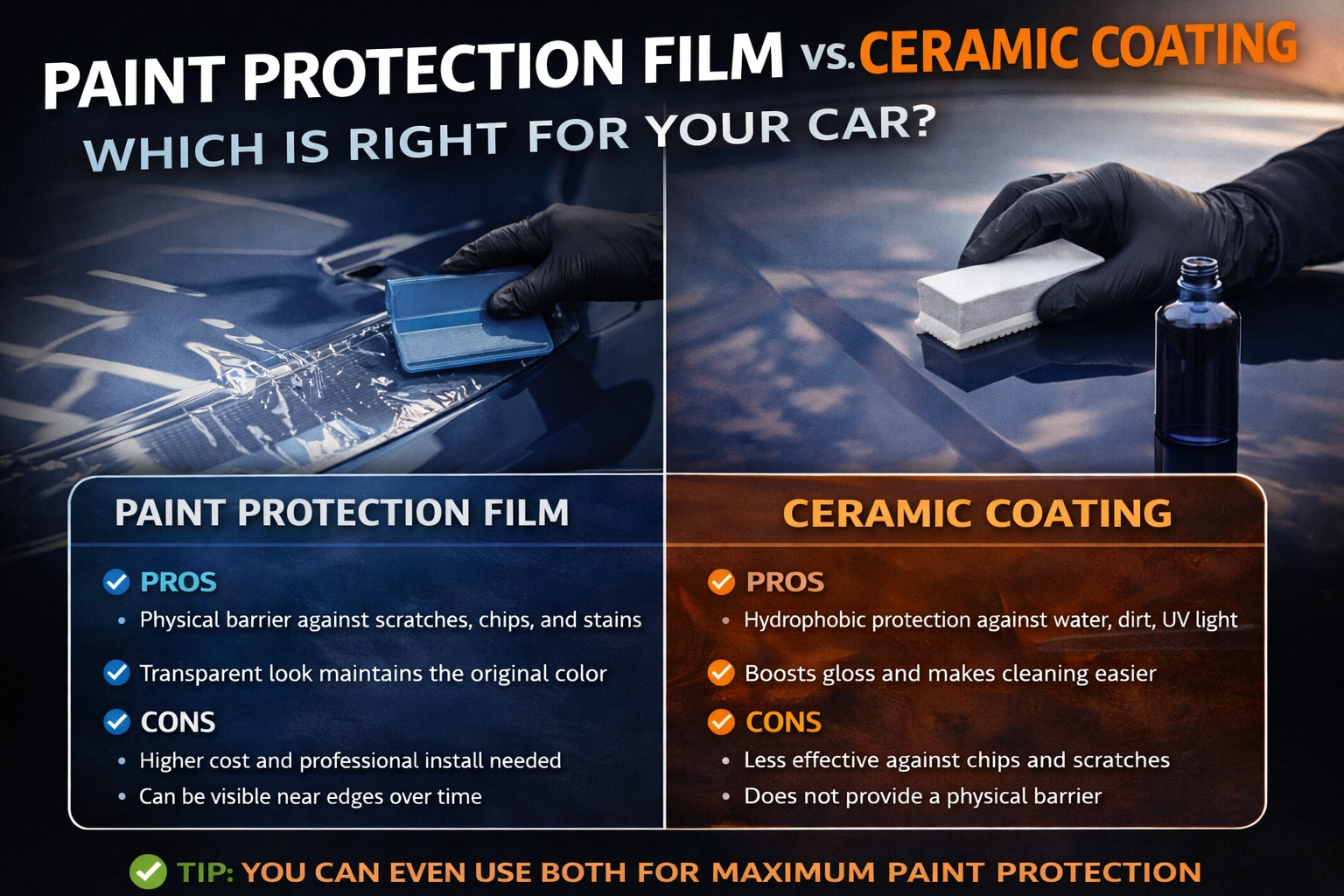
Paint Protection Film vs Ceramic Coating: What Fits Your Budget
Paint Protection Film (PPF) is an 8–10 mil clear polyurethane skin that physically absorbs rock chips, minor scratches, and bug acid. Ceramic coating is a 0.1–0.5 micron chemical layer that bonds to clearcoat and makes washing dramatically easier while resisting UV and light etching. They solve different problems. Full-front PPF costs $1,800–$3,500 and protects against impact damage. Professional ceramic costs $600–$2,000 and changes how the paint maintains itself. For long-term paint preservation on a newer car, the industry standard is PPF on the front-end impact zones plus ceramic over the entire vehicle.
What each product actually does
PPF (paint protection film), sometimes called clear bra, is a thermoplastic polyurethane film 8–10 mils thick (roughly the thickness of 10 sheets of printer paper). Modern self-healing PPFs — XPEL Ultimate Plus, SunTek Ultra Plus, and 3M Scotchgard Pro Series — contain an elastomeric topcoat that reflows at temperatures above 130°F, erasing light swirls. The film is installed wet, squeegeed into place, and cures over 24–72 hours. It protects from:
- Rock chips at highway speed (documented in XPEL's independent impact testing down to roughly 40 mph at pea-gravel size)
- Bug acid etching during long-distance summer driving
- Minor parking-lot contact and brush scratches
- UV yellowing of the paint underneath (top-tier films carry 10-year non-yellow warranties)
Ceramic coating is a silicon-dioxide (SiO2) based liquid that chemically bonds with the clearcoat at the molecular level. After cure, it forms a sacrificial hydrophobic layer typically 2–3 hardness points above factory paint on the pencil hardness scale (roughly 9H claims in marketing, 3H–4H in independent lab testing). It does not absorb impact damage. What it does:
- Sheets water and road dirt so cars stay cleaner between washes
- Resists bird droppings, tree sap, and bug acid for 10–30 minutes of contact (gives you time to rinse without etching)
- Blocks UV oxidation that dulls paint over years
- Makes hand washing 30–50% faster — dirt releases with less agitation
Real cost ranges (2025 U.S. professional pricing)
Based on shop quotes sampled nationally from installer-certified dealers:
- PPF partial front (bumper + hood leading edge + mirrors, ~"track package"): $900–$1,600
- PPF full front (bumper + full hood + fenders + mirrors + headlights): $1,800–$3,500
- PPF full vehicle: $6,500–$12,000 on a sedan, $8,000–$18,000 on a large SUV
- Ceramic coating, 1-year consumer grade (e.g., System X Diamond, CarPro CQuartz): $400–$700
- Ceramic coating, 3–5 year professional (Gtechniq Crystal Serum Ultra, Feynlab Heal Plus, Ceramic Pro 9H): $900–$2,000
- Graphene-enhanced coatings (Adam's, Feynlab): $1,200–$2,500; no meaningful durability gain over top ceramics in long-term testing, mostly a marketing upgrade
Warranty: read past the headline number
Marketing materials emphasize "10-year" PPF or "lifetime" ceramic warranties. The fine print matters:
- XPEL Ultimate Plus carries a 10-year transferable warranty against yellowing, cracking, and peeling — but not against impact punctures or edge lifting.
- 3M Scotchgard Pro Series is 10 years against yellowing, 7 years against other defects.
- Ceramic Pro "Lifetime" warranty requires annual inspection at an authorized installer ($150–$300 per visit) and ceramic maintenance of specific products. Skipping a single annual check voids the warranty.
- Gtechniq Crystal Serum Ultra provides a genuine 9-year durability guarantee when installed by a Gtechniq Accredited detailer, with far fewer maintenance requirements.
The separate question: is the warranty from the product manufacturer or the installer? Installer-backed warranties disappear when the shop closes or loses certification. Manufacturer-backed warranties (XPEL, 3M, Gtechniq, CarPro) survive installer changes.
Who should buy PPF, ceramic, or both
Three common scenarios:
- Leased vehicle, 36-month term, mostly garage-kept: skip PPF. A good 3–5 year ceramic ($900–$1,500) makes turn-in easier and keeps the car looking new at a fraction of PPF cost.
- Highway commuter with many miles in front of trucks: full-front PPF is the priority. Ceramic alone does not stop rock chips. Add ceramic over the rest of the vehicle once PPF is installed.
- New $60,000+ car planning to keep 7+ years: partial PPF on bumpers, hood leading edge, mirrors, and rocker panels ($1,200–$1,800) plus a top-tier ceramic coating over the entire vehicle ($1,200–$2,000) is the industry standard setup. Total $2,400–$3,800, breaking even against paint correction costs within 4–5 years.
Preparation matters more than product choice
Both coatings only bond properly to perfectly clean, contamination-free paint. Professional prep on a new car takes 4–8 hours and includes:
- Two-bucket decontamination wash with pH-neutral shampoo
- Iron-particle decontamination (chemical spray such as CarPro Iron X)
- Clay bar to remove bonded contaminants
- One-step polish (machine-applied with foam pad and light-cut compound) to remove factory micromarring
- Isopropyl alcohol wipe (50% dilution) to strip polish residue
- Tack cloth pass immediately before application
Skipping any of these steps locks contaminants under the coating permanently. A quote under $500 for a full ceramic install on a new vehicle almost always indicates a shop skipping prep — which means the coating bonds to contamination instead of paint, and it will fail within 6–12 months.
Maintenance rules for each
PPF: hand wash only, pH-neutral shampoo. Avoid automatic brush washes (touchless is fine). Apply a dedicated film sealant every 6 months — standard ceramic sprays are acceptable on modern PPFs but some older films react with certain chemistries. Never use tar or bug removers on the film unless rated for PPF.
Ceramic coating: hand wash with pH-neutral shampoo every 1–2 weeks. Avoid any product containing silicone, wax, or polymer sealant — they sit on top of the ceramic and block its hydrophobic performance. Use a ceramic-safe spray topper every 2–3 months (Gyeon WetCoat, CarPro HydrO2, Koch-Chemie FSE) to reinforce water beading.
Frequently asked questions
Can I install ceramic coating myself?
Yes, entry-level consumer kits such as CarPro CQuartz UK 3.0 and Gyeon Q2 Pure are DIY-accessible for $80–$200 and deliver 12–24 months of durability when applied correctly. The non-negotiable prerequisite is proper prep — see the preparation section. A fully prepped DIY ceramic will outperform a professional "shampoo and apply" install done without prep.
Is PPF visible on the paint?
Top-tier modern films (XPEL Ultimate Plus, SunTek Ultra Plus) are optically clear when professionally installed and bulk-wrapped. Seams and edges are visible on close inspection, especially on metallic silver paints where light catches the edge differently. For high-metallic colors, ask to see the installer's previous work on the same shade.
How long does professional installation take?
Full-front PPF: 1–2 days. Full-vehicle PPF: 3–5 days. Professional ceramic with prep: 1–2 days. Plan for the car to be unavailable and kept indoors for the stated cure period — typically 48 hours for PPF, 24 hours for ceramic, with 7 days before exposure to rain or car wash recommended by most manufacturers.
Does ceramic coating fill scratches?
No. It is too thin. Scratches and swirl marks should be corrected by machine polishing before ceramic is applied — the coating will lock in whatever paint condition it bonds to. This is why professional installs include paint correction as a line item; a "ceramic over uncorrected paint" package preserves existing defects permanently.
How do I know when the coating is wearing off?
Watch water behavior. A healthy ceramic creates tight, beaded droplets that slide off the surface when the car moves. When beads flatten into broad sheets or water sits on the paint without releasing, the top layer has degraded. A ceramic-safe spray topper restores roughly 6–8 months of performance; full reapplication requires prep and is due every 3–5 years depending on the product.