
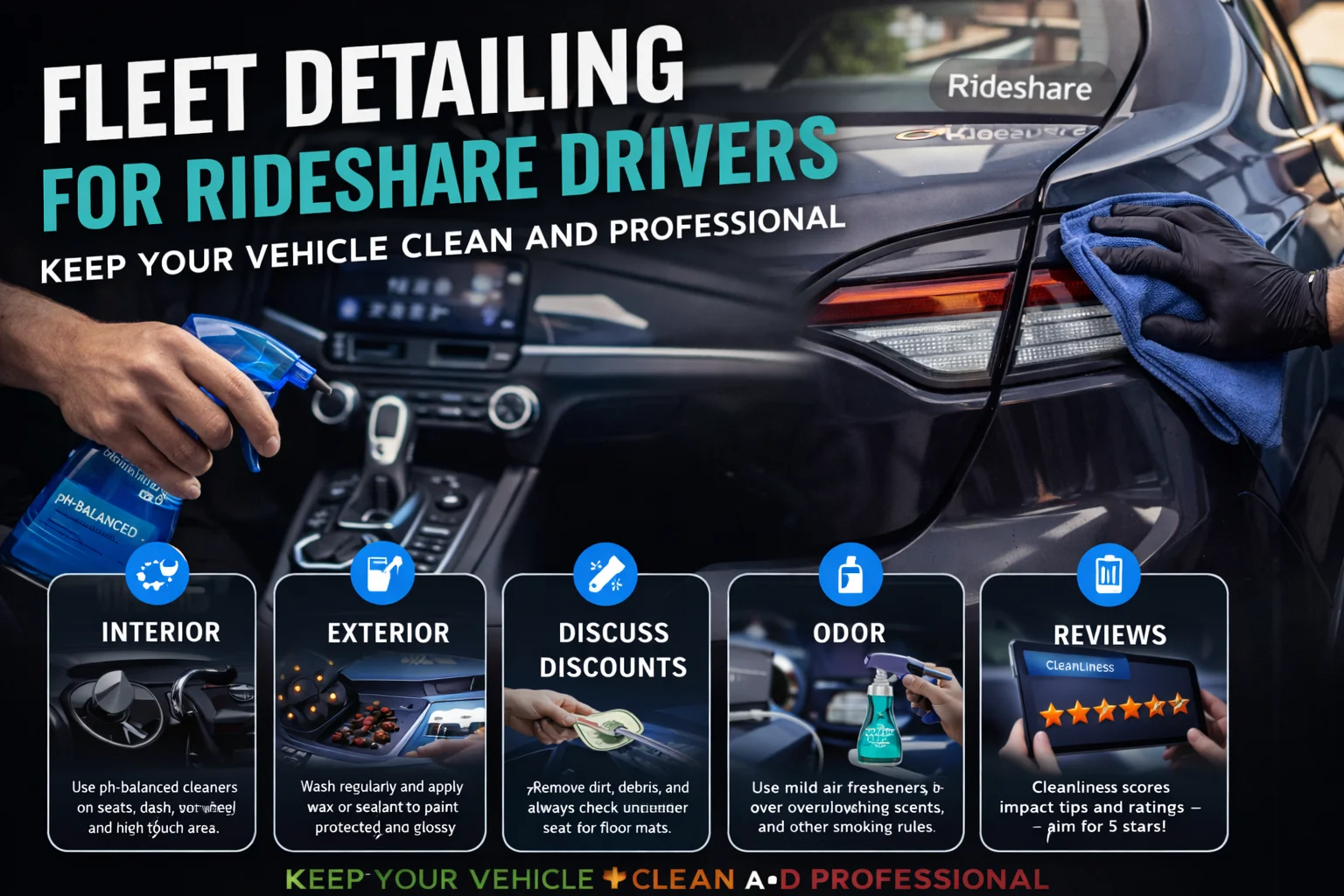
Fleet Detailing Tips for Rideshare and Delivery Drivers
A rideshare driver putting 50,000+ miles per year on one vehicle needs a detailing approach optimized for time and passenger perception, not concours appearance. The economics are simple: a clean vehicle earns 10–15% higher ratings and 8–12% more tips on Uber and Lyft per 2024 Gridwise driver survey data, while taking 35 minutes per week at home. Here is the routine that rideshare full-timers actually use — cheap consumables, a weekly cycle, and protective products that handle the high wear patterns of constant-entry passenger vehicles.
What rideshare does to a car that commuting doesn’t
Full-time rideshare drivers put roughly 3–4× the miles on a vehicle compared with personal commuting, but more importantly, the vehicle sees 50–100 distinct passenger entries per week. Each entry brings:
- Boot dirt on the rear floor mats and lower door jambs
- Hand grime on the door handle, armrest, seatback
- Hair and lint on seats
- Food and drink residue on cupholders and door pockets
- Occasional spills — coffee, soda, fast food grease
The cumulative effect on an un-maintained vehicle is visible within 60 days and can drop an Uber rating by 0.1–0.3 stars in that timeframe — enough to disqualify from Uber Premier or Lyft Lux programs where premium rates require 4.85+ rating.
The 35-minute weekly routine
Most rideshare full-timers structure weekly cleaning around Sunday evening (before Monday-morning peak shifts). Total time: 35 minutes. Total consumable cost: under $3 per session.
- Rinse-and-run exterior wash (7 min): $5–$8 touchless auto wash. Weekly minimum during salt or bug seasons.
- Interior vacuum with dedicated tools (10 min): handheld cordless vacuum with crevice tool and brush attachment. Target: between seats, footwells, cupholders, center console tray, door pockets.
- Surface wipe (8 min): interior multi-surface wipes (Armor All, Meguiar's, or generic Costco wipes). Target: dashboard, center console, steering wheel, door handles inside and outside, seat bolsters where passengers grip.
- Glass clean (5 min): microfiber towel with glass cleaner. Target: windshield inside (streaks dramatically affect passenger perception at night), side windows, rear window. Streak-free interior glass is one of the highest-impact items for ratings.
- Air freshener refresh (2 min): plug-in or vent clip freshener, changed weekly or biweekly. Avoid overpowering scents; most drivers prefer unscented or light “new car” or vanilla.
- Floor mat shake-out (3 min): rubber mats rinsed in the driveway weekly. Carpet mats vacuumed, swapped quarterly if reversible.
Essential products and what they cost per month
- Interior multi-surface wipes: $6–$9 per canister (lasts ~4 weeks)
- Microfiber towels: $15 for pack of 12, lasts 6–8 months
- Glass cleaner: $5 per bottle, lasts ~3 months
- Leather/vinyl conditioner: $12–$18 per bottle, monthly use
- Carpet cleaner (for spills): $10–$15 per bottle
- Automatic car washes: $32–$48 per month (weekly $8)
- Air freshener: $10–$20 per month
Total monthly cost: $80–$120. For a driver generating $4,000–$6,000 in monthly gross fares, this is under 3% of revenue — paid back many times over by the rating and tip uplift.
Seat protection: spend here, save later
The single highest-ROI investment for rideshare vehicles is waterproof seat covers on the rear seats (where most passengers sit). Options:
- Custom-fit neoprene covers (FH Group, Seatcover.com): $80–$180 per rear row, machine-washable, fit correctly around seatbelt anchors and headrest posts.
- Universal waterproof covers (Black Panther, Gorla): $50–$90 per set, less fitted, easier to install and remove.
- Factory leather or leatherette: if the vehicle has it, wipe weekly with leather conditioner containing UV blockers (Leatherique, Chemical Guys Leather Cleaner + Conditioner). Leather in a rideshare vehicle survives indefinitely if maintained; breaks down rapidly if neglected.
The economic case: one bad spill on an unprotected cloth seat often requires professional carpet extraction at $75–$150 per occurrence, or a $600+ reupholstery if the stain is permanent. Seat covers at $100–$150 pay for themselves after the first avoided deep cleaning.
Handling spills: the 10-minute window
When a spill happens mid-shift, the response in the next 10 minutes determines whether it becomes a $0 fix or a $150 professional extraction. Minimum carry-kit contents (fits in the glovebox):
- Microfiber towel (dedicated for spills, not glass)
- Bottle of carpet spot cleaner (Folex, Woolite, or Bissell)
- Pack of antibacterial wipes
- Disposable gloves (2 pairs)
- 2 large plastic bags for disposal
Spill protocol:
- Pull over safely. Put hazards on if on the street.
- Absorb liquid with the microfiber towel, dabbing (not scrubbing) to avoid spreading.
- Apply spot cleaner lightly, wait 30 seconds, blot.
- If passenger is still in vehicle, offer wipes and apologize for the interruption.
- End shift early if the spill is extensive or creates an odor that will affect subsequent passengers.
Monthly deep clean
The weekly routine keeps the vehicle presentable; a monthly deep clean restores it to a fresh-from-the-lot state. Options:
- DIY at home (2 hours): wet-extract carpets with rented or owned extractor ($130 for a Bissell ProHeat), leather deep-condition, full interior detail. Consumables: $8–$15.
- Professional express detail ($80–$150): 45–60 minute service at a dedicated detailing business. Faster, often better results on deep-embedded stains.
- Full detail quarterly ($200–$350): comprehensive service including shampoo extraction, leather conditioning, trim dressing, and exterior clay-and-polish. Recommended every 3–4 months.
Vehicle choice matters
Some vehicles are inherently easier to keep rideshare-clean:
- Leather or high-quality leatherette seats clean faster than cloth
- Flat-bottomed cupholders without textured insets clean with a single wipe
- Dark interior colors (black, charcoal) hide staining better than beige or light gray
- Rubber floors (F-150, Wrangler, some base-trim trucks) rinse clean in 2 minutes versus 15 for carpet
Toyota Camry, Honda Accord, Toyota RAV4, and Honda CR-V remain the most popular rideshare vehicles specifically because their interiors are engineered for durability and ease of cleaning at scale.
Frequently asked questions
How often does Uber or Lyft inspect my vehicle?
Uber and Lyft both require annual vehicle inspections through approved inspection networks. The inspections cover safety items (tires, brakes, lights) rather than cleanliness. Cleanliness is enforced through passenger ratings and complaints; repeated low ratings trigger account review and potential deactivation.
Can I deduct car cleaning costs on taxes?
Yes. Car washes, interior detailing, cleaning supplies, and seat covers are deductible as ordinary business expenses when the vehicle is used primarily for rideshare. Keep receipts and track the business-use percentage. At 90%+ rideshare use (a true full-timer), the full cost is deductible; at mixed use, the deduction is proportional.
Do passengers actually care how clean the car is?
Gridwise's 2024 survey of rideshare passengers ranked cleanliness as the #2 factor in tipping decisions (after driver personality). Specifically, interior odor, visible debris in footwells, and fingerprint smears on glass were the three most-cited complaint categories.
What’s the best air freshener for a rideshare car?
Vent clips (Febreze, Little Trees) refreshed weekly are the industry standard. Avoid strong scents — cinnamon, bubblegum, strong florals — that often trigger passenger sensitivity. Unscented odor eliminators (Febreze Unstopables or Ozium spray for deep odor removal) are the safest default.
How long does a rideshare car typically last?
With the weekly maintenance routine and monthly deep cleans, a modern Camry or Accord used full-time (50,000 miles/year) typically reaches 250,000–350,000 miles before major component failures. The limiting factor is usually transmission or battery on hybrids, not interior wear.