
Ceramic-Coated Car Wash Mistakes to Avoid
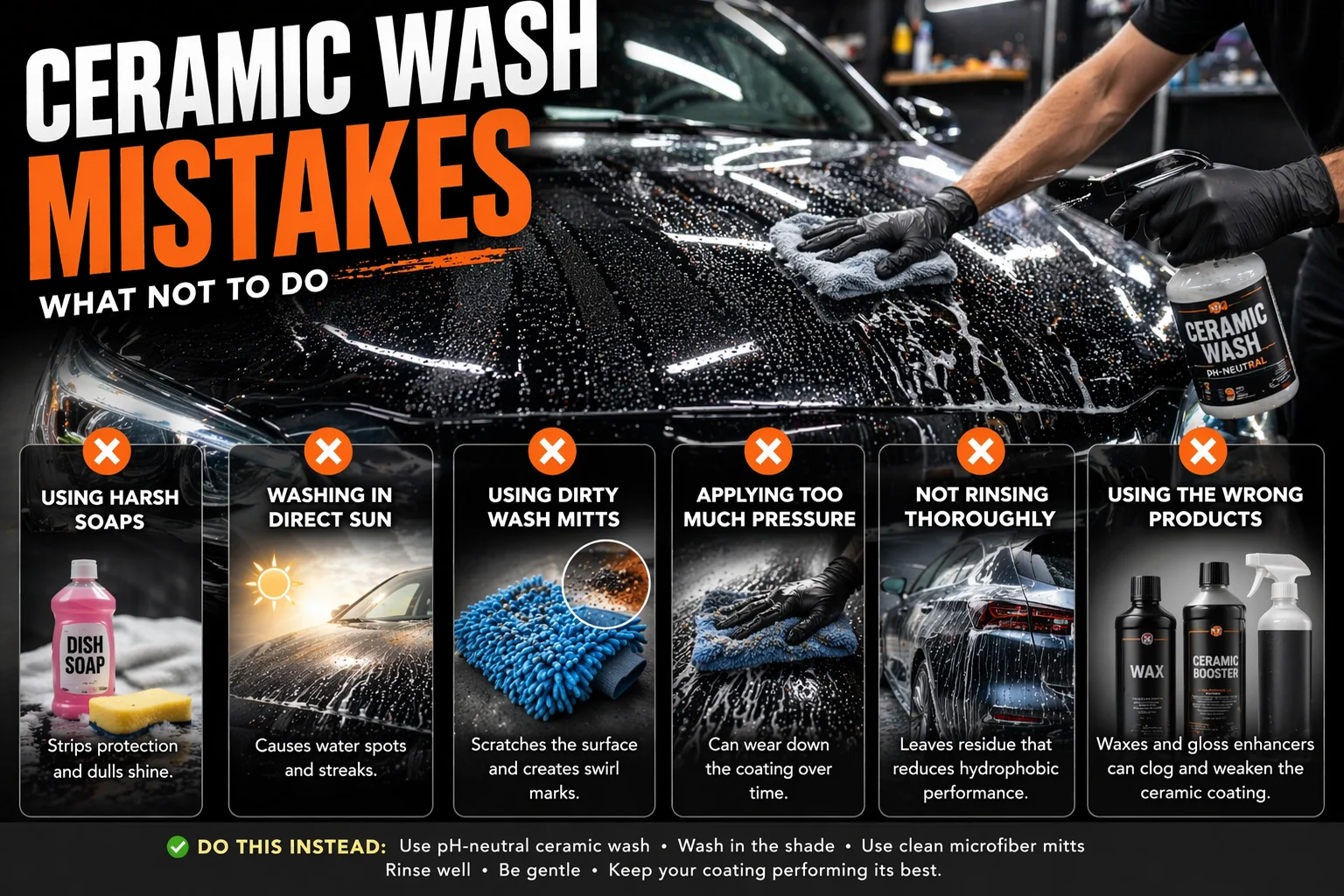
Ceramic coating is a chemical layer on your paint, not a forcefield — and the way you wash a ceramic-coated vehicle determines whether the coating lasts 6 months or 5 years. Five mistakes account for most premature coating failures: using alkaline shampoos designed for conventional paint, letting water dry on the coating, using contaminated wash mitts, skipping the decontamination step before top-up coatings, and applying traditional waxes on top of ceramic. Each shortens coating life dramatically. Here is the wash routine that actually lets ceramic deliver its advertised performance.
Why ceramic maintenance differs from conventional paint
A ceramic coating is a silicon-dioxide layer chemically bonded to the clearcoat. It works by creating a low-surface- energy hydrophobic surface — water and dirt cannot adhere as easily, so contaminants slide off with light agitation rather than requiring scrubbing.
The bond degrades through three mechanisms:
- High-pH chemicals (alkaline soaps, bug removers, iron removers misapplied) that break silicon-oxygen bonds
- Physical abrasion from contaminated wash media that grinds through the sacrificial top layer
- Mineral deposition (water spots) that becomes permanently bonded within the coating structure
Each mechanism is avoidable with the right technique.
Mistake #1: Using conventional car shampoo
Standard car shampoos (Meguiar's Gold Class, Chemical Guys Mr. Pink, Turtle Wax Ice) are formulated for conventional paint and typically sit at pH 8–10 (mildly alkaline). On uncoated paint this is fine. On ceramic, repeated alkaline exposure progressively breaks down the siloxane bonds.
Use a pH-neutral shampoo (pH 6.5–7.5) specifically rated for coated vehicles:
- Gyeon Q² Bathe+ – pH-neutral, made for ceramic
- CarPro Reset – strong hydrophobic reactivation
- Koch-Chemie GSF – professional-grade pH-neutral
- Adam's Car Shampoo – pH-neutral, consumer-friendly
- Chemical Guys HydroSuds – pH-neutral with SiO2 additives
Avoid dish soap entirely. Dish soap (Dawn, Palmolive) is extremely alkaline and surfactant-heavy — it strips wax and sealant within minutes and substantially shortens ceramic coating life.
Mistake #2: Letting water dry on the coating
Water contains minerals (calcium, magnesium, silica). On conventional paint, water spots are a cosmetic annoyance that can be polished out. On ceramic, mineral spots bond inside the coating structure and are permanent without re-coating.
Wash and dry protocol:
- Wash in shade when possible; if in sun, work one panel at a time
- Rinse thoroughly with clean water, ideally deionized for the final rinse on hard-water areas
- Dry within 2–3 minutes of final rinse using large plush microfiber drying towels (The Rag Company Gauntlet, Autofiber Flip)
- Use a leaf blower (Ryobi, DeWalt cordless, Metro Vac) to blow water out of mirror housings, wheel wells, door jambs, badges, and trim edges
If water spots do form and are caught within 1–2 weeks, mild alkaline water-spot remover (CarPro Spotless at 5:1 dilution) safely removes them. Older bonded water spots require machine polishing and often re-coating of the affected panel.
Mistake #3: Contaminated or reused wash media
Every wash mitt, towel, and wash media that has touched the ground, a dirty car, or another vehicle contains embedded grit. Using contaminated media on a ceramic- coated car abrades the top of the coating on every wash. Within 10–20 washes the sacrificial top layer is gone and performance drops visibly.
Specific rules:
- Use two-bucket wash method (separate soap and rinse buckets, both with grit guards)
- Use a dedicated wheel mitt — never wash wheels with the paint mitt
- Replace or wash mitts and drying towels with microfiber-safe laundry detergent (no fabric softener, which destroys microfiber's cleaning ability)
- Retire wash media that has been dropped, used on the ground, or used on substantially contaminated paint
Mistake #4: Skipping decontamination before re-coating
Most ceramics include a “topper” product — a lighter coating applied every 3–6 months to restore hydrophobic performance. Applying topper without proper surface prep creates a layered barrier that locks contaminants into the bond.
Before applying a ceramic topper (CarPro HydrO2, Gyeon WetCoat, Koch-Chemie FSE):
- Wash with ceramic-safe shampoo
- Decontaminate with iron remover (CarPro Iron X, Gyeon Iron)
- Clay bar the surface lightly to remove bonded contaminants
- Wipe with 50% isopropyl alcohol to strip any residue
- Apply topper per product instructions, work a panel at a time
Skipping any of these is the equivalent of painting a wall without cleaning it.
Mistake #5: Using traditional waxes on top of ceramic
Wax and sealant products contain carnauba, polymers, synthetic resins — all substances that sit on top of ceramic rather than bonding with it. The result: they block the ceramic's hydrophobic performance, accumulate dirt, and create a cloudy appearance. When washed off, they often leave streaks requiring polishing to remove.
Post-ceramic, only use ceramic-safe products:
- Ceramic-compatible spray waxes (Gyeon, CarPro)
- Pure SiO2 sprays without polymer additives
- Dedicated ceramic toppers (see Mistake #4)
Avoid any product advertising “wax plus polymer blend” or “synthetic sealant” on a ceramic-coated vehicle. These are designed for bare or waxed paint.
The correct ceramic wash routine
End-to-end weekly or biweekly protocol:
- Pre-rinse with strong pressure to remove loose debris (2–3 minutes per side)
- Foam pre-wash with a dedicated ceramic-safe foam (CarPro Reset Foam, Koch-Chemie Magic Foam) — dwell 3–5 minutes, rinse
- Contact wash with two-bucket method, top-down direction, chenille or merino wool mitt
- Wheel wash with dedicated mitt and ceramic-safe wheel cleaner (Sonax Full Effect, Koch-Chemie Green Star)
- Final rinse with clean water
- Drying with plush microfiber and leaf blower for crevices
- Quick detailer or spray topper (monthly) to reinforce water beading
Total time: 45–75 minutes for a sedan, 60–90 for an SUV. This is no longer than a conventional wash but uses different products.
When to re-coat
Signs a ceramic coating needs refresh or full reapplication:
- Water beads flatten from tight droplets to broad sheets
- Surface no longer sheets water when the car is in motion
- Visible texture to the paint when rubbed with a clean microfiber
- Noticeable cleaning effort increase versus original
First sign: apply a spray topper. If performance does not restore, schedule a full decontamination and re-coat. Consumer-grade coatings (CarPro CQuartz UK, Gyeon Q² Pure) last 12–24 months. Professional coatings (Gtechniq Crystal Serum Ultra, Feynlab Heal Plus, Ceramic Pro 9H) last 3–5 years.
Frequently asked questions
Can I use an automatic car wash on ceramic coating?
Touchless (no-brush) automatic washes are safe. Brush-style automatic washes are not recommended — brush abrasion and recycled water accelerate coating wear dramatically, even if most individual washes look clean.
How often should I apply ceramic spray topper?
Every 4–8 weeks for typical daily drivers in salt-belt or hot-weather areas; every 2–3 months in mild climates. Sign to reapply: water begins sheeting rather than beading. Do not apply more frequently than every 4 weeks — build-up of topper can cloud the base coating.
Will rain water damage ceramic?
Only if it dries on the surface. Soft rain that the car dries off quickly is no issue. Acid rain in urban industrial areas (pH 4–5) accelerates coating wear and leaves etching if not rinsed within hours. Park under cover when possible after heavy-acid-rain events.
What if I accidentally used dish soap on my coated car?
A single application will not destroy the coating, but expect a measurable reduction in hydrophobic performance that may persist 1–2 weeks. Reapply a ceramic topper after the next proper wash to restore performance. Repeated dish-soap use substantially shortens coating life.
Can I use ceramic spray on my windshield?
Dedicated ceramic glass products (Gyeon Q² View, CarPro Flyby30) are specifically formulated for glass and improve rain repellency. Generic paint ceramic coatings applied to glass often streak and blur visibility. Keep products separated by intended surface.