
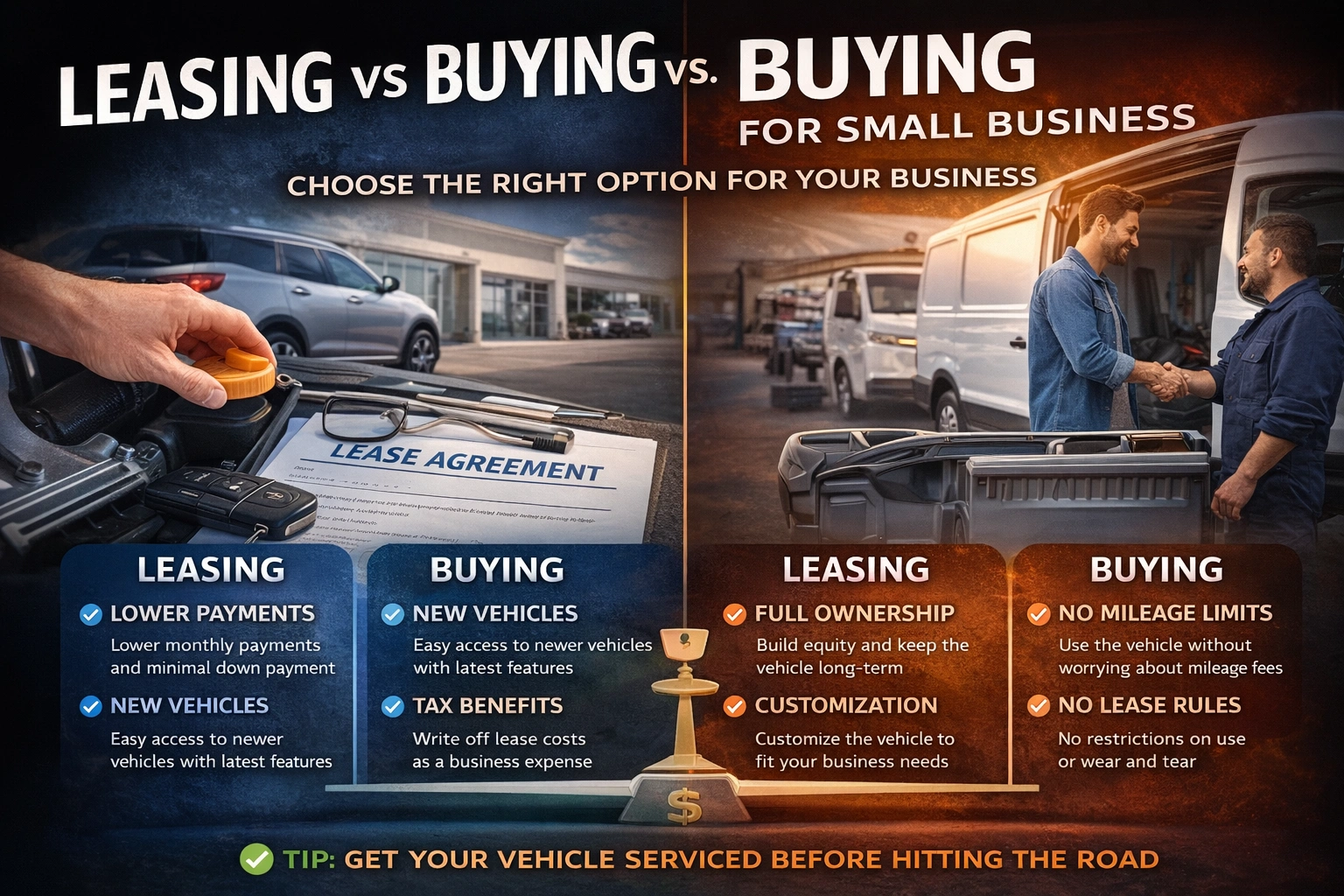
Leasing vs Buying a Vehicle for a Small Business Fleet
For most U.S. small businesses running 1–10 vehicles, buying outright wins on total cost over five years, financing wins on cash flow, and leasing wins only when the business needs to refresh the fleet every 36 months or cannot absorb depreciation on its books. The decision comes down to three numbers: annual mileage, expected holding period, and whether the vehicles weigh more than 6,000 pounds gross vehicle weight — because that single figure changes the federal tax treatment more than any other factor.
The three-number test
Before comparing quotes, answer these three questions for the specific vehicle you intend to put in service:
- Will any driver exceed 15,000 miles per year? Standard business leases allow 12,000–15,000 miles annually. Overage penalties run $0.15–$0.30 per mile. Contractors, service technicians, and sales reps routinely drive 25,000+ miles — at that rate a lease costs $3,000–$4,500 in overage fees over 36 months.
- How long will you actually keep the vehicle? If the answer is five years or more, buying almost always wins. If it is three years or less and the vehicle is needed for a finite project or contract, leasing is often cheaper despite the lack of residual asset.
- Does the vehicle weigh over 6,000 pounds GVWR? Light trucks, full-size SUVs, and cargo vans above this threshold qualify for Section 179 expensing and bonus depreciation at dramatically higher caps than passenger cars, which are locked into the Section 280F "luxury auto" limits.
The 2025 tax math: Section 179 and bonus depreciation
For 2025 tax years, Section 179 of the Internal Revenue Code allows small businesses to expense up to $1,250,000 in qualifying property in the year it is placed in service, subject to a $3,130,000 phase-out. Vehicles below 6,000 lbs GVWR are capped under Section 280F at $12,400 in first-year depreciation for passenger autos (and roughly $20,400 including bonus depreciation, per the 2024 IRS Revenue Procedure guidance).
Vehicles over 6,000 lbs GVWR (and under 14,000 lbs) can qualify for Section 179 expensing up to $31,300 in 2025, plus 40% bonus depreciation on the remaining basis. A $75,000 service van used 100% for business could yield roughly $48,000–$56,000 in first-year deductions under this structure. The same dollar amount spent on a Lexus sedan would be capped around $20,400.
Lease deductions work differently. Lease payments are deductible as an ordinary operating expense in proportion to business use — but the IRS adds an "inclusion amount" back to income for leased luxury vehicles, published annually in the Revenue Procedure. In practice this reduces the tax benefit of leasing a high-value car to a level similar to owning it and taking depreciation.
Cash flow: where leasing genuinely helps
Leasing usually requires little or no down payment. A three-year lease on a $42,000 work truck typically runs $450–$650 per month with $2,000–$3,500 at signing. Financing the same truck with a 20% down payment would tie up roughly $8,400 in cash and run $650–$780 per month on a five-year loan. For a business building inventory, upgrading equipment, or paying quarterly estimated taxes, that working capital difference matters more than the long-term cost math.
This is the scenario in which a true operating lease is worth considering. Under ASC 842 accounting standards (effective for private companies in 2022), most leases now appear on the balance sheet as a right-of-use asset and corresponding liability, which reduced but did not eliminate the off-balance-sheet benefit. For businesses with debt covenants that penalize fixed assets, a short-term operating lease is still the cleaner treatment.
Total cost over 60 months: a worked comparison
Consider a $45,000 full-size work van used 100% for business at 20,000 miles per year, held for five years, financed at 7% APR or leased through three rolling 36-month contracts.
- Finance and keep 5 years: $8,000 cash down, $730/month × 60 = $43,800, plus $1,800 first-year acquisition tax deduction benefit. Residual value at year 5 (roughly 35%): $15,750 equity. Net cost: approximately $36,050 after resale.
- Lease three 36-month terms: $2,500 per lease × 3 = $7,500 at signing, $575/month × 60 = $34,500. No residual. Likely mileage overage across terms: $3,500. Net cost: approximately $45,500.
- Pay cash and keep 5 years: $45,000 upfront, no financing charges. Residual $15,750. Net cost: roughly $29,250 — but $45,000 of working capital is tied up for five years.
The $9,000–$16,000 difference in favor of ownership assumes the vehicle holds up mechanically. Break even usually arrives at month 42–48. Lease only if you will realistically turn the vehicle over before that point.
What changes for fleets of 5 or more vehicles
Fleet programs offered by manufacturers (Ford Pro, GM Envolve, Stellantis Fleet) typically start at 5–10 unit commitments and unlock meaningfully better terms: fleet discounts of 3–8% on MSRP, pooled mileage across vehicles on leases, negotiated wear-and-tear standards, and in some cases maintenance bundled into the monthly payment. At this scale, a structured lease with a commercial fleet manager can outperform individual financing on cash flow and administrative overhead, even if the raw cost math slightly favors ownership.
Insurance, maintenance, and the hidden line items
Commercial auto insurance for a leased vehicle typically requires higher liability minimums than owned vehicles (often $1 million combined single limit versus $500,000) because the leasing company is an additional insured. Expect to pay an extra $400–$900 per vehicle per year in premium, which tips the five-year math further against leasing.
Lease-end reconditioning charges on business-use vehicles average $800–$2,200 per unit based on data published by J.D. Power's lease retention studies. Document every pre-existing issue at delivery with timestamped photos and keep them accessible at turn-in.
Frequently asked questions
Can I write off 100% of a business vehicle in year one?
Only if the vehicle weighs over 6,000 lbs GVWR, is used more than 50% for business, and is placed in service during the tax year. Heavy SUVs and pickups often qualify; passenger cars do not, because of Section 280F caps. Even then, the total Section 179 election cannot exceed the business's taxable income — unused deduction carries forward.
Is a business lease taxable differently than a personal lease?
Yes. Business lease payments are deductible as operating expense to the extent of business use, but the IRS requires adding back an annual "inclusion amount" for leased vehicles above a published fair market value threshold. The current table is in IRS Publication 463 and Revenue Procedure 2024-13.
What happens if my lease goes over mileage?
Every mile over the contract allowance triggers a per-mile penalty, typically $0.15–$0.30. On a 36-month lease with 5,000 excess miles, that is $750–$1,500 at turn-in. Some dealers allow pre-purchasing additional miles up front at roughly half the post-lease rate — worth it if you know you will exceed.
Does leasing help my business credit?
Commercial leases report to business credit bureaus (D&B, Experian Business) the same way financing does. A consistent payment history on either builds a business credit profile. Personal guarantees are usually still required for small-business leases.
What is better for a contractor who puts 30,000 miles a year on a truck?
Financing and keeping the truck 5–7 years. At 30,000 miles per year, a standard lease's overage penalties alone will exceed $4,500 over 36 months, and the dealer will not offer a reasonable high-mileage lease option on a new vehicle. Buy, run it to 180,000–220,000 miles, and sell it privately.