
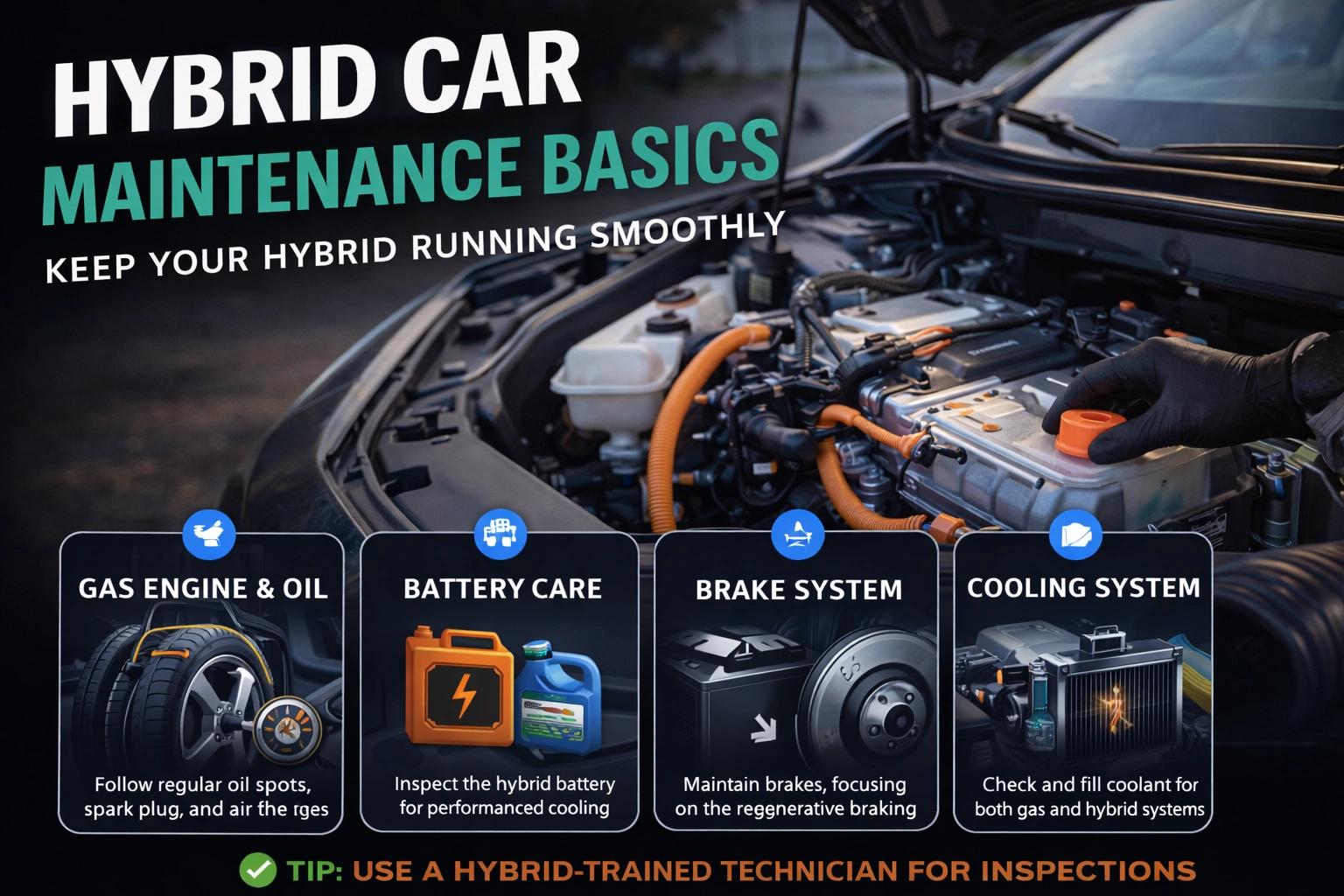
Hybrid Car Maintenance Basics for First-Time Owners
Hybrids follow the same maintenance rhythm as gasoline cars with four important differences: brake pads last two to three times longer, the high-voltage battery has its own cooling system, the 12-volt auxiliary battery becomes the most common cause of no-starts, and federal law covers hybrid components for at least 8 years or 100,000 miles under U.S. EPA emissions warranty rules. Most first-time hybrid owners spend less on service, not more, if they understand those four differences up front.
Regenerative braking: why your pads last longer
Every time a hybrid slows down, the electric motor switches into reverse and works as a generator — slowing the car while putting energy back into the battery. That process, called regenerative braking, does most of the stopping work for you. Friction pads only engage during the final few miles per hour of a stop or during hard braking.
The practical result: pad and rotor wear on a hybrid is typically 40–60% lower than on an equivalent gasoline car. Toyota, Honda, and Ford service schedules list brake pad inspections every 15,000 miles but many owners reach 80,000–100,000 miles on the original set. What you do need to watch for is rotor rust. Pads rarely touch the rotors, so surface corrosion builds up, especially in snow-belt states. A quality technician will clean or resurface rotors during normal inspections even when pads have plenty of life left.
Practical checkpoint: ask your shop to measure pad thickness and note rotor condition at every tire rotation. If the tech insists on full brake replacement at 30,000 miles, get a second opinion.
The high-voltage battery: cooling is the job
The traction battery (the large pack that powers the electric motor) is engineered to last the life of the car. Toyota Prius data collected by independent rebuilders such as The Hybrid Shop consistently shows 15–20 year service lives on original NiMH packs when the cooling system is maintained.
That cooling system is the single most important thing you can watch. Most hybrids pull air from the passenger cabin through an intake vent — often located behind the rear seat or under a cargo panel — and blow it across the battery pack. If that vent is blocked by a car seat, luggage, or years of pet hair in the filter, the pack runs hotter than designed and degrades faster.
Three habits keep the cooling system healthy:
- Clean or replace the battery fan filter every 30,000 miles. Most dealers charge $30–$60 for this and many skip it unless asked.
- Never block the intake vent. Check your owner's manual for its exact location.
- Avoid leaving the car in direct sun for weeks at a time without driving it — especially in climates where cabin temperatures exceed 120°F.
The 12-volt battery: the real no-start risk
This is the finding that surprises almost every first-time hybrid owner. The large traction battery does not start the car — a small, traditional 12-volt auxiliary battery does. It powers the computer that wakes the hybrid system up. When the 12V dies, the car will not boot, regardless of how much charge the traction battery holds.
12V batteries in hybrids typically last 4–6 years, shorter than in a gasoline car because the hybrid system uses them constantly to keep computers on standby. Replace yours preemptively at the five-year mark. Expect to pay $180–$350 at a dealer or $120–$220 at an independent. Some hybrids use an AGM (absorbent glass mat) battery that must be matched exactly — a cheaper conventional lead-acid substitute will cause warning lights and shortened life.
Engine oil, coolant, and tires: what is actually different
The gasoline engine in a hybrid runs less often than in a conventional car, so oil is not burned off as quickly, but it does absorb more moisture from repeated cold starts. Follow the interval in your owner's manual (typically 10,000 miles or 12 months for most 2015+ hybrids) and do not extend it past the time limit just because the mileage is low.
Hybrids have two separate coolant loops: one for the engine, one for the inverter and hybrid transaxle. Both need to be serviced on the schedule listed in your owner's manual — typically 100,000–150,000 miles for the long-life coolant used in most modern hybrids. A shop that services only the engine coolant is doing half the job.
Tires wear slightly faster on hybrids because the cars carry an extra 150–300 pounds of battery and motor, and because the instant torque from the electric motor is harder on front tires in front-wheel-drive designs. Rotate every 5,000 miles and expect 45,000–55,000 miles from a low-rolling-resistance tire — compared with 55,000–65,000 on a similar non-hybrid.
Federal warranty protection you already paid for
Under U.S. Environmental Protection Agency emissions warranty rules (40 CFR Part 86), every hybrid sold in the United States is covered on hybrid-specific components for at least 8 years or 100,000 miles, whichever comes first. In California and the states that follow CARB emissions standards, that coverage extends to 10 years or 150,000 miles on the traction battery.
Covered components generally include the traction battery, electric motor or motor-generator unit, power control module, and the hybrid-specific portion of the transmission. Keep every maintenance receipt. If a warranty claim is ever denied, the manufacturer must prove that owner neglect caused the failure — and a clean service record is your strongest defense.
Realistic cost expectations
Based on published dealer service pricing and AAA cost-of-ownership data, a first-time hybrid owner should budget the following in the first five years:
- Oil changes (5–6 over five years): $350–$550 total
- Tire rotations every 5,000 miles: $0–$240 total (often free at dealer)
- One full tire replacement at ~50,000 miles: $600–$1,000
- Battery fan filter cleaning (2 services): $60–$120 total
- 12V battery replacement at year 5: $120–$350
- Brake inspection and rotor cleaning: $200–$400 total
- Hybrid-specific diagnostic scan at year 4: $80–$150
That totals roughly $1,400–$2,800 over five years for a hybrid, compared with $2,200–$3,800 for an equivalent gasoline car over the same period — mostly due to the extended brake life and smaller number of oil changes.
Frequently asked questions
Do hybrid batteries really last 10+ years?
In most cases, yes. Toyota and Ford publish data showing that over 85% of original traction batteries in their hybrid fleets from model years 2010–2015 are still in service as of 2025. The single biggest predictor of long battery life is keeping the cooling system clear and driving the car regularly rather than letting it sit.
Can I service a hybrid at an independent shop, or do I need a dealer?
Most routine service — oil, tires, brakes, 12V battery, filters — can be done at any shop with a trained technician. For hybrid-specific work such as traction battery diagnostics, inverter coolant service, or module-level repairs, seek out a shop that certifies its techs in high-voltage systems. The I-CAR and ASE L3 (Light Duty Hybrid/Electric) credentials are the current benchmarks.
What signs mean my hybrid battery is failing?
Three early warning signs: fuel economy drops noticeably over a few weeks (a 15% decline often indicates weak cells), the battery-charge gauge swings from full to empty faster than it used to, and the engine runs more often at low speeds because the system can't rely on electric propulsion. A dealer or hybrid specialist can run a state-of-health scan that confirms the pack's actual capacity.
Is it worth buying an extended hybrid battery warranty?
Usually no. The federal 8/100,000 warranty (or 10/150,000 in CARB states) already covers the most expensive scenario. Beyond that, replacement packs from independent rebuilders typically cost $1,500–$2,800 installed — often less than a multi-year extended warranty premium.
Should I plug in a non-plug-in hybrid if I can?
Standard hybrids (HEVs) cannot be plugged in — they charge the traction battery only through regenerative braking and the gasoline engine. If your car has a charging port, it is a plug-in hybrid (PHEV) and yes, plug it in whenever possible: running primarily on electricity roughly doubles the service interval of the gasoline engine.