
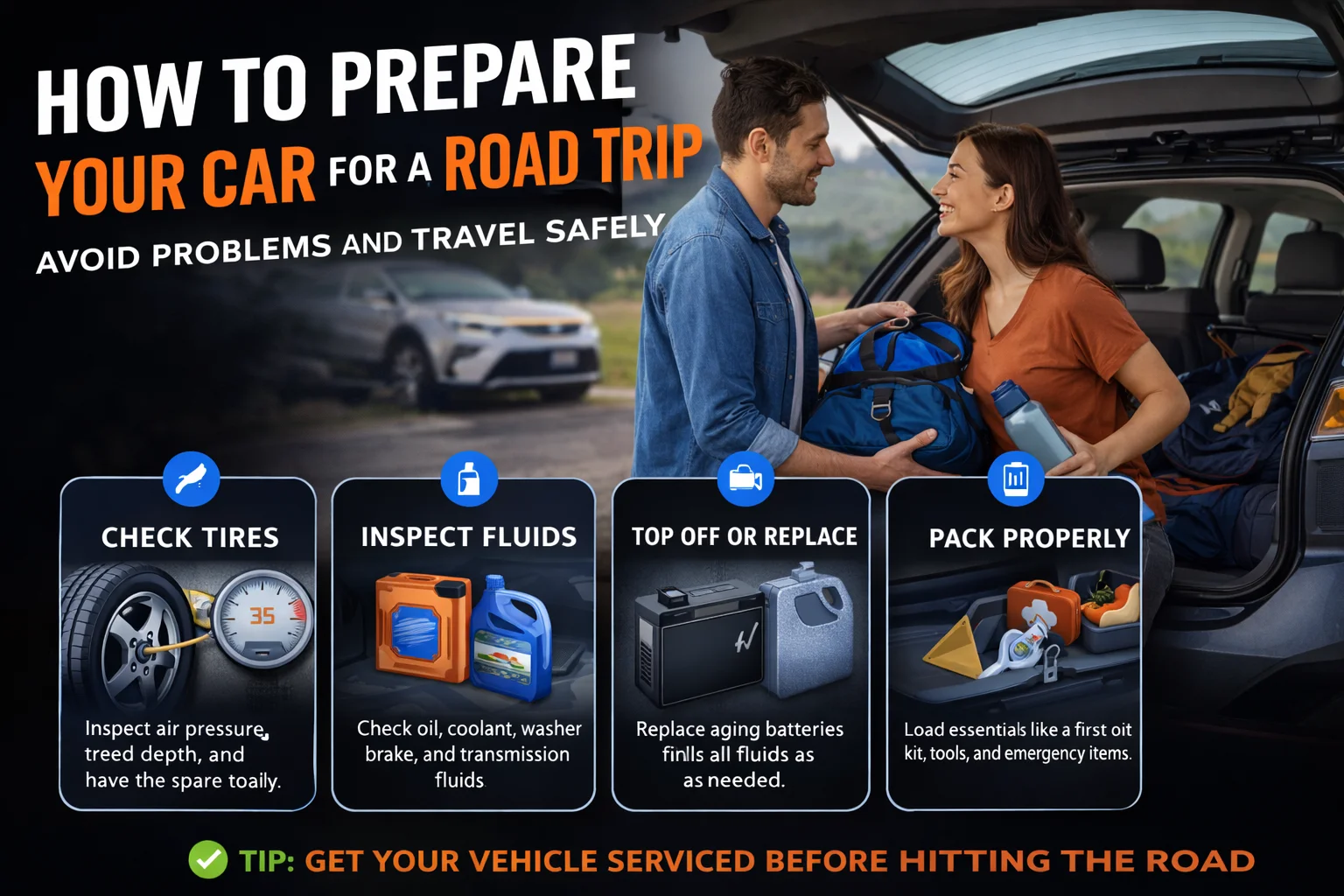
How to Prepare Your Car for a Long Spring Road Trip
AAA data shows that 40% of the roadside assistance calls its network responds to during May–September are for problems that a 30-minute pre-trip inspection would have identified: flat tires from under-inflation or age-cracked sidewalls, dead batteries over 4 years old, and overheating from low coolant or failed thermostats. A proper spring road trip prep takes two hours, costs under $60 in consumables, and prevents the most common interstate breakdowns. This guide is the checklist used by commercial fleet operators before long-haul deployments, adapted for family-car use.
Tires: the single biggest roadside risk
Tires cause more roadside incidents than any other vehicle system by a wide margin. A complete tire check covers four things, in order of frequency of failure:
- Pressure: check cold (parked 3+ hours) and inflate to the door-jamb placard value, not the number molded on the tire sidewall (that is the maximum). Correct pressure typically runs 32–36 PSI for sedans and 35–40 PSI for SUVs and light trucks. Under-inflation below 25% of the placard value triggers the federal TPMS warning light but is already causing 8–12% fuel economy loss and accelerated sidewall heat buildup.
- Tread depth: use the penny test. Insert a penny upside-down into the tread; if the top of Lincoln's head is visible, tread is under 2/32" and legally worn out. For highway speed and possible wet conditions, replace when depth drops below 4/32" — wet-road stopping distance doubles between 4/32" and 2/32" per Consumer Reports wet-brake testing.
- Age: check the DOT code on the sidewall. The last four digits are the week and year of manufacture (e.g., "2322" = 23rd week of 2022). Tires over 6 years old develop sidewall cracking from UV and ozone regardless of tread depth. NHTSA and most manufacturers recommend replacement at 6–10 years maximum.
- Spare and jack: confirm the spare is properly inflated (often 60 PSI on compact "donut" spares), locate the jack and wrench, and know how to use them before leaving. A surprising number of modern vehicles ship without a spare at all — they carry inflator kits or rely on run-flats. Know what yours has.
Fluids: the five-minute check that matters
Most fluid checks take minutes with the hood open. Do them with the engine cold and on a level surface.
- Engine oil: pull the dipstick, wipe, reinsert, and read. Level should be between the two hash marks. Oil color is a secondary signal: honey-brown is fresh, dark brown is normal for mileage, black and gritty indicates an overdue change. If more than 500 miles remain on the oil interval when you return, change it before the trip.
- Coolant: check the reservoir (translucent plastic tank, usually labeled "Engine Coolant" or with a thermometer icon). Level should be between MIN and MAX marks when cold. Never open the radiator cap of a warm engine — pressurized coolant causes burns.
- Brake fluid: reservoir is mounted on the firewall, usually yellow-tinted plastic. Fluid should be pale yellow to straw-colored; dark brown indicates moisture contamination and the system should be flushed before a long trip involving mountain descents.
- Washer fluid: fill completely. Spring trips often encounter bug splatter at night when stops are inconvenient.
- Power steering and transmission fluid: only check if your vehicle has dipsticks (many modern vehicles have sealed transmissions with no user-accessible fluid check).
Battery and charging system
A battery over 4 years old should be load-tested before any trip longer than 500 miles. Most auto-parts chains (AutoZone, O'Reilly, Advance Auto Parts) offer free battery testing and will print a specific-gravity and cold-cranking amp reading. Replace if:
- Cold cranking amps have dropped below 70% of rated capacity
- Battery date code is over 5 years old (printed on the top or side label)
- The vehicle has had slow-crank symptoms, especially in cold weather
Clean battery terminals with a wire brush and apply a light coat of dielectric grease. Corroded terminals cause intermittent charging faults that look like alternator failure.
Brakes and wiper blades: easy to see, easy to fix
Brake wear varies enormously by driver but a useful benchmark: pad thickness below 3mm warrants replacement before a long trip involving mountain descents. On most front disc brakes, you can inspect pad thickness through the wheel spokes with a flashlight.
Wiper blades older than 12 months should be replaced before spring driving. UV degrades rubber unevenly, and chattering blades during heavy rain at highway speed reduce visibility dramatically. Bosch, PIAA, and Rain-X premium blades run $20–$35 each and install in under 5 minutes.
Emergency kit essentials
A minimum roadside kit assembled from AAA and Red Cross recommendations fits in a small duffel and costs $50–$80 total:
- Jumper cables (6 gauge, 20 feet) or a self-contained lithium jump starter
- Reflective warning triangles or LED road flares (3 minimum)
- Tire inflator / 12V compressor and tire plug kit
- Tire pressure gauge (mechanical, not digital — digital fails at extreme temperatures)
- Flashlight with extra batteries or rechargeable
- First-aid kit rated for 2 people minimum
- Multi-tool (Leatherman, SOG, or similar)
- Duct tape and zip ties
- Blanket or emergency mylar blankets
- Water: at least 1 gallon per person for any trip through remote areas
- Non-perishable snacks (protein bars, trail mix) for 24 hours per person
- Phone charging cable and a cigarette-lighter or USB-C power adapter
For trips through mountain passes, add chains or cable traction devices for your tire size, a small folding shovel, and a bag of sand or kitty litter for traction.
Route planning and documentation
Before leaving:
- Download offline Google Maps or Apple Maps tiles for the entire route — cellular coverage gaps are common in Montana, Wyoming, the Dakotas, West Texas, and parts of the Southeast
- Identify fuel stops every 200–250 miles, not every 350 miles (cushion for headwinds, detours, closures)
- Confirm insurance card and current registration are in the glovebox
- Note your roadside assistance number (AAA, manufacturer program, or credit-card concierge) in your phone
- Share itinerary with someone not traveling with you
Frequently asked questions
How long before the trip should I do the inspection?
Seven to ten days. This leaves time to order parts or book service if the inspection reveals a problem. A Friday inspection for a Saturday-morning departure gives you zero options if the battery tests weak or the tire age is out of spec.
Should I change the oil before a long trip?
Only if the oil is over 80% of its service-life interval by the time you return. If the trip will add 2,500 miles and you are currently at 4,000 miles on a 10,000-mile interval, you will return at 6,500 miles — well within limits, no change needed. Synthetic oils in modern vehicles easily handle the continuous highway mileage of a road trip.
Do I need roadside assistance if I have a new car warranty?
Most new-car warranties (Toyota, Honda, GM) include 3–5 year roadside programs — typically capped at basic service (tire change, jump start, lock out). AAA and credit-card concierge services add towing coverage for longer distances and priority dispatch during high-traffic holidays, which is the single biggest value for cross-country travel.
What is the safest speed for long highway trips?
Both fuel economy and mechanical stress peak around 70 mph for most vehicles. Every 5 mph above 60 mph costs roughly 7% fuel economy (Department of Energy data), so maintaining 65–70 mph saves meaningful money over a 1,500-mile trip while keeping pace with modern interstate traffic. Above 80 mph, tire heat buildup becomes a safety factor, especially on older tires.
How do I prepare an EV for a road trip?
In addition to the standard checklist, pre-plan DC fast-charger stops using PlugShare or A Better Route Planner, confirm adapter availability (NACS / CCS / Tesla Supercharger support varies by vehicle), pre- condition the battery before each fast-charge stop on vehicles that support it (faster sessions), and expect cold-weather range reductions of 20–35% if crossing into high-altitude or winter conditions.