
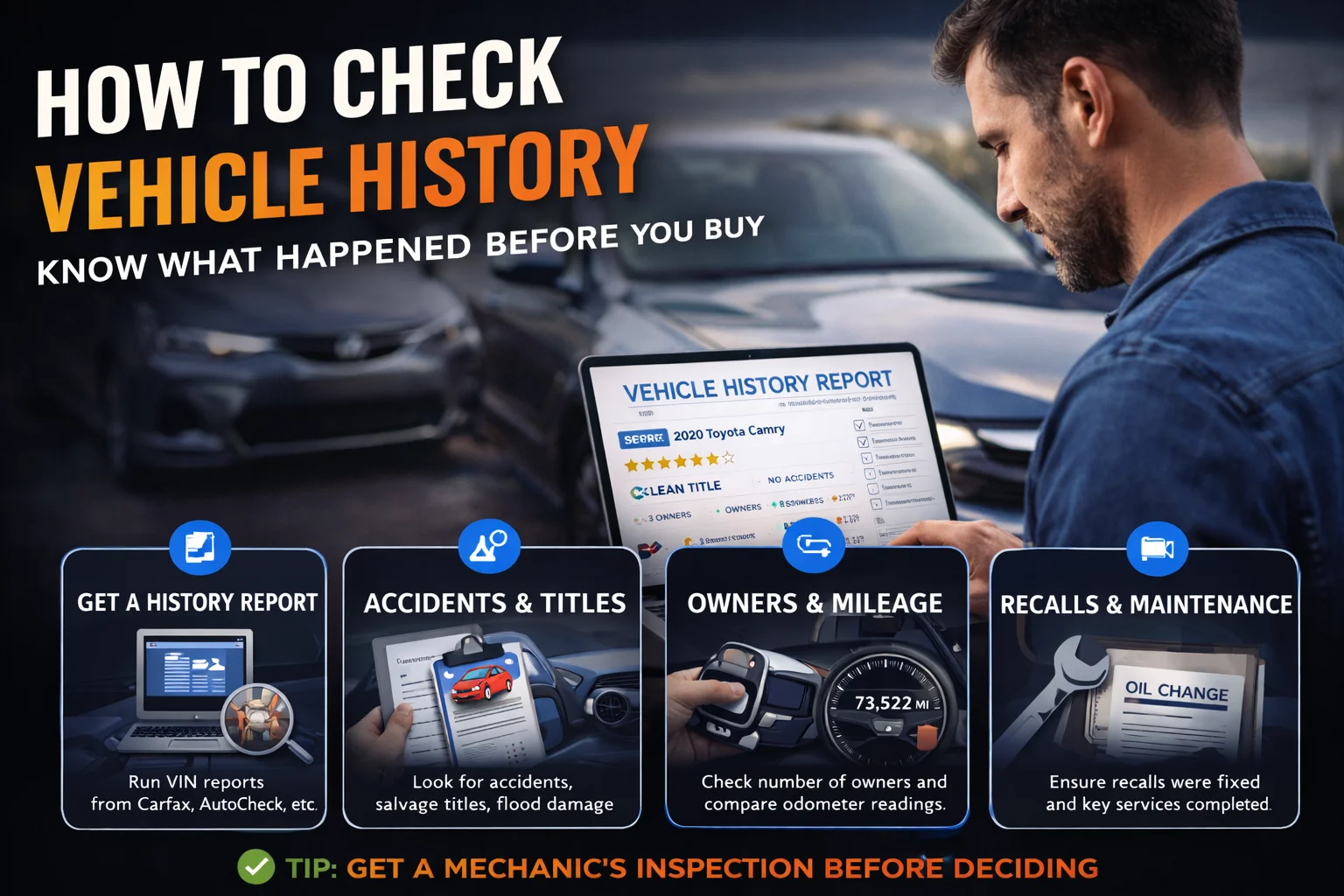
How to Check a Vehicle History Report Before You Buy
A complete used-car history check uses three sources in sequence: NHTSA’s free VIN lookup for open recalls, a $40–$50 Carfax or AutoCheck report for accident and title history, and a $125–$200 pre-purchase inspection at an independent shop to verify mechanical condition. Skipping any of the three misses different types of risk: NHTSA catches safety recalls insurers cannot see, paid reports catch accidents DMV never recorded, and physical inspection catches curbstoning, odometer tampering, and flood damage that no database reliably tracks. Total cost: under $250. Total savings from catching a single flood-damaged title: $4,000–$15,000.
Step 1: NHTSA recall check (free, takes 2 minutes)
Before paying for any database report, check the VIN directly at nhtsa.gov/recalls. This is the federal government's authoritative recall database, free to the public, updated within 48 hours of new recall issuance.
What it catches: open recalls, especially safety-related ones (airbag inflators, seat belts, steering components, fuel system issues) that the seller may not have completed. Roughly 25% of recalled vehicles in the used market still have unrepaired recalls per NHTSA's own 2023 completion-rate data.
Recall repairs are free to the current owner when performed at a franchise dealer. Budget: 1–4 hours of dealer time. Do not buy a used vehicle with open critical-safety recalls until they are completed — or negotiate the purchase price down by the value of the time commitment plus any associated rental.
Step 2: Paid history report (Carfax or AutoCheck)
Carfax and AutoCheck aggregate data from DMVs, auto auctions, repair facilities, insurance companies, and law enforcement. Coverage varies:
- Carfax has stronger dealer and service center data, better at detecting consistent maintenance patterns. $40 per report, $50 for 3 reports.
- AutoCheck has stronger auction data, better at detecting auction-flipped vehicles and salvage chain-of-title. $25 per report, $50 for unlimited reports for 21 days.
- NMVTIS-sourced reports (via VinAudit, ClearVin): $15–$20, based on the federal National Motor Vehicle Title Information System. Stronger at title and theft detection, weaker at accident history.
For a thorough check on a vehicle worth $15,000+, pull both Carfax and AutoCheck. The two databases report different things; each misses events the other catches. The $65–$90 total cost is trivial relative to the purchase.
What paid reports catch
- Title changes: each time ownership transferred. Frequent transfers (4+ owners in 5 years) on a low-mileage vehicle can indicate hidden problems that caused repeated resales.
- Branded titles: salvage, rebuilt, flood, hail, lemon-law buyback, manufacturer buyback. A branded title reduces value 20–50%.
- Reported accidents: when insurance companies filed claims. Missing from the report does NOT mean no accidents — just that none were reported to insurance or the DMV.
- Odometer readings at title transfer and service: inconsistent or decreasing readings suggest odometer tampering, a federal crime and a guaranteed reason to walk away.
- Registration state history: vehicles registered repeatedly in flood-affected states (Louisiana, Florida, North Carolina after hurricanes) or salt-belt states (used vehicles from Minnesota, Illinois, Ohio) carry different risk profiles.
- Commercial or rental use: sometimes disclosed, often not. Commercial-use vehicles typically have 2–3× the wear of private-use vehicles at equivalent mileage.
What paid reports miss
Three critical things Carfax and AutoCheck often cannot detect:
- Minor accidents repaired privately. A $4,000 bumper replacement paid in cash never touches insurance or DMV. Carfax will not know. Visual inspection of body panels and paint thickness with a gauge ($30–$80 tool) is the only way to detect.
- Flood damage before title washing. Flooded vehicles are often trucked across state lines and re-titled clean in a different state, a process called "title washing." Recent federal reforms (NMVTIS participation expansion) have reduced but not eliminated this. Inspect for mud in wiring harnesses, corroded seat rails, musty interior odors, and fog inside headlights.
- Curbstoning (unlicensed dealer flipping). Individuals who buy and flip cars without a dealer license often skip required title transfers. Check that the seller's name appears on the title and matches their ID. If the last title transfer was weeks before your purchase and the seller claims to be the long-term owner, walk away.
Step 3: Pre-purchase inspection (PPI)
A PPI at an independent shop specialized in the vehicle's brand costs $125–$200 and takes 60–90 minutes. The mechanic performs:
- Road test for transmission behavior, braking, alignment
- Computer diagnostic scan for stored and active fault codes
- Visual inspection of frame welds, floor pans, and structural members for evidence of collision repair
- Paint thickness measurement on every exterior panel (factory paint: 90–140 microns; repainted panels: 150–250+ microns)
- Fluid leak inspection (engine, transmission, differentials, power steering)
- Brake, tire, and suspension component assessment
- Interior function check (all electronics, climate, safety systems)
A good PPI report identifies $500–$3,000 worth of issues most private sellers omit or do not know about. On vehicles with $15,000+ asking price, it pays for itself routinely.
Red flags found only in physical inspection
- Welds that look professional but are not factory: factory welds have consistent pattern and color; repair welds are usually cruder. A body-shop-savvy technician sees this in 30 seconds.
- Paint overspray on trim, glass edges, or undercarriage: indicates a resprayed panel, regardless of what Carfax says.
- Replaced airbag covers without logged deployment: a replaced airbag cover with no record of deployment or recall service suggests a hidden collision.
- Waterline inside doors or seats: moisture staining inside footwells, behind rear seats, or on seat rail mounts indicates past flooding.
- Mismatched panel gaps: doors, hoods, and trunks with visibly uneven gaps indicate frame or body damage.
Total time and cost budget
A full history verification on a used vehicle:
- NHTSA VIN recall check: 2 minutes, free
- Carfax + AutoCheck reports: 10 minutes, $65–$90
- Pre-purchase inspection: 1–2 hours (drop off, PPI, pickup), $125–$200
- Personal visual and test-drive inspection: 30 minutes, free
Total: under 3 hours, under $300. On a $25,000 used vehicle that is 1.2% of purchase price, which routinely catches $1,000–$10,000 in hidden issues and saves much more in avoided lemons.
Frequently asked questions
Do I really need both Carfax and AutoCheck?
For vehicles worth over $15,000, yes. Each catches events the other misses. On vehicles under $10,000, one report plus a PPI is usually sufficient.
How reliable is a “clean” Carfax?
Not fully reliable. Carfax misses accidents that were paid privately, some title brands in states with weak reporting, and older events on vehicles over 15 years old. A clean Carfax reduces risk but does not eliminate it — physical inspection is the only way to confirm condition.
Can I tell if a car was in a flood just by looking?
Sometimes. Signs include waterline staining on seatbelt retractors, mud residue inside wiring harnesses and under carpet edges, heavy rust on screws and clips under seats, fog or moisture inside headlamp housings, and musty odor that air freshener can't fully cover. A PPI mechanic experienced with flood cars identifies these routinely.
Is a dealer CPO inspection enough, or should I still do my own PPI?
For mainstream manufacturer CPO programs (Toyota, Honda, BMW, Porsche, Lexus), the official CPO inspection is thorough and the extended warranty covers most hidden defects. An independent PPI is still a good investment on vehicles over $30,000 — it is a second opinion and catches issues the dealer will not volunteer.
What about private-seller vehicles with no dealer involvement?
PPI is non-negotiable. Private sellers have no warranty obligation, no institutional reputation to protect, and no certification standards. A private-sale PPI is the single most important cost on any used-car transaction — refuse to buy from a seller who prohibits one.