
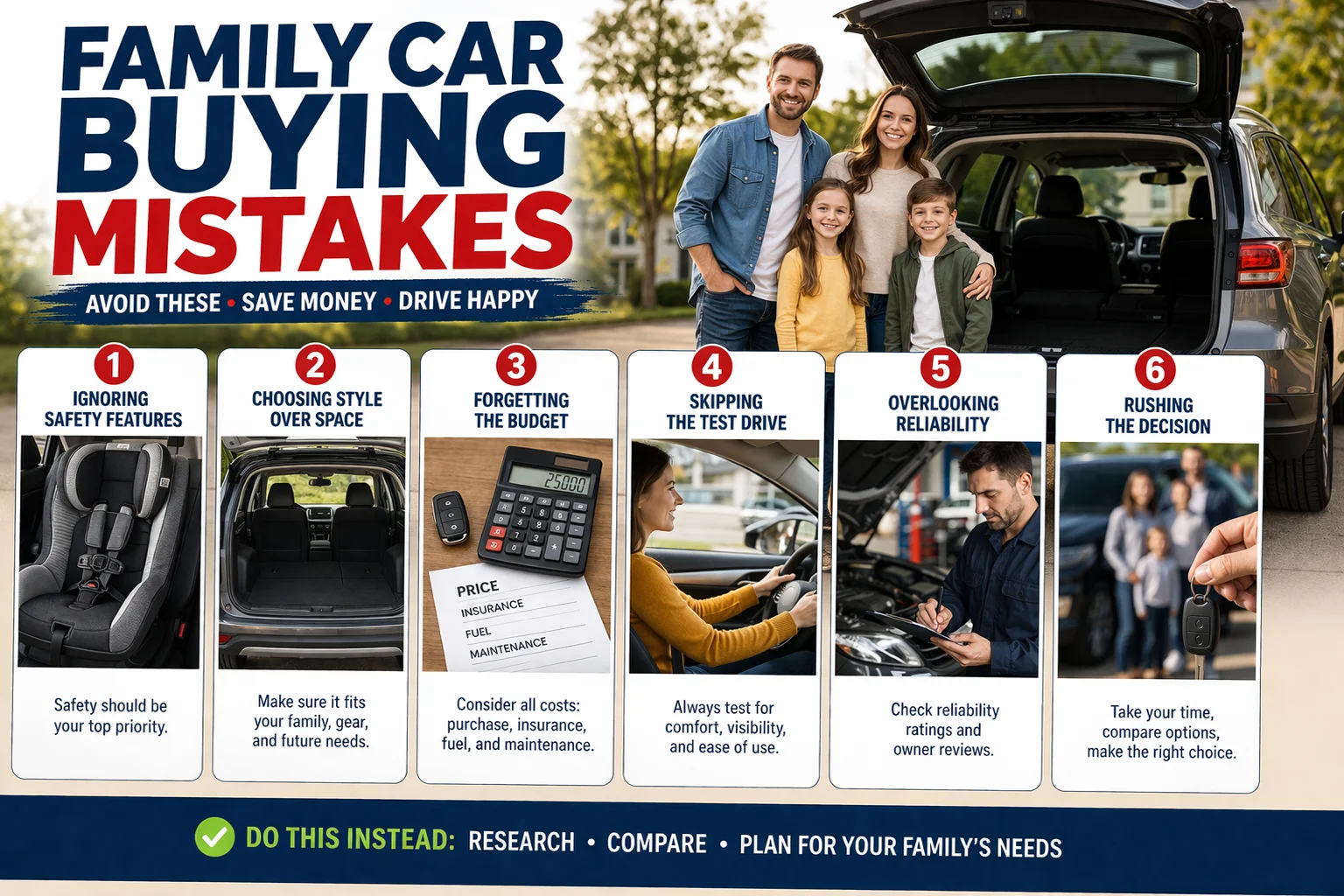
Seven Family Car Buying Mistakes That Cost More Than You Think
Families overspend on vehicles in remarkably predictable ways: buying too much size for actual use, confusing "monthly payment" with "total cost," overlooking car-seat geometry that makes a three-row SUV functionally a five-seater, skipping insurance quotes before signing, and trusting single-source reliability rankings. The seven mistakes below each quietly add $1,500–$8,000 to the true cost of family vehicle ownership over the first three years. Avoiding them does not require expertise — just knowing where to look before the test drive.
Mistake #1: Buying too much vehicle for actual use
The most common family SUV regret, documented in J.D. Power's 2024 Vehicle Dependability Study, is buying a three-row SUV when a two-row would have been enough. The full-size third row on a mainstream SUV (Kia Telluride, Honda Pilot, Ford Explorer) adds roughly $4,000–$6,000 to MSRP, reduces real-world combined fuel economy by 2–3 mpg, and increases insurance premiums by 8–12%. If the third row is used fewer than 20 times a year, a two-row vehicle with a hitch-mounted cargo carrier is a substantially cheaper solution.
Before shopping, count: how many days in the last 12 months did you actually carry more than 5 people? If the answer is under 15, start with two-row vehicles. Upgrade only if the answer changes.
Mistake #2: Optimizing monthly payment instead of total cost
Dealers quote family vehicles in monthly terms because stretching the loan from 60 to 84 months drops the payment $80–$140 but adds $3,000–$6,000 in total interest at current rates. Experian's 2024 automotive finance report showed the average new-vehicle loan term hit 68.5 months, with 84-month terms now representing roughly 17% of all new auto loans.
Three rules for loan length:
- 60 months maximum for new vehicles. Beyond 60 months, the vehicle typically depreciates faster than the loan principal amortizes, leaving the owner "underwater."
- 48 months maximum for used vehicles. Used cars already depreciated in the first 3 years; a long note on a depreciating asset compounds the risk.
- If you cannot afford the 60-month payment, shop a cheaper vehicle. Every 12 months added to the loan is a quiet vote against your equity.
Mistake #3: Not measuring car-seat geometry before signing
Two 2024 mid-size SUVs with identical paper specs can have dramatically different child-seat compatibility. The problem is the angle of the rear seatback, the flatness of the seat bottom, the height of the LATCH anchors, and whether a forward-facing seat lets a driver's seat still recline.
Before the test drive, bring the car seats you already own. Install them in the positions your children will actually use. Check:
- Can a rear-facing seat fit behind a 6-foot front passenger without that passenger having the front seat contacting the knees?
- Do three seats actually fit across the second row, or do two booster seats plus a narrow convertible overlap the center belt?
- Is the third-row access aisle wide enough for an adult to load a child into a third-row seat, or does it require removing the center second-row seat?
The NHTSA LATCH ratings (available at nhtsa.gov) measure ease of installation but not geometric fit — that requires the physical seat in the actual vehicle.
Mistake #4: Assuming "reliability" applies to the specific model-year
Consumer Reports and J.D. Power reliability rankings combine multiple model years and body styles. A brand's overall score may be strong while the specific model-year you're considering has known issues. Toyota's reputation, for example, holds broadly but the 2020–2022 RAV4 Hybrid had documented fuel pump and battery-cooling issues covered by a TSB (Technical Service Bulletin).
Before buying, check the NHTSA Recall and Complaints Database at nhtsa.gov for the exact year, make, model, and trim. Search for "investigations" not just recalls — issues under active investigation often become recalls later and indicate what problems cluster. A model with 200+ complaints on the same component signals a pattern regardless of brand reputation.
Mistake #5: Skipping insurance quotes before committing
Insurance premiums on family vehicles can vary $600–$1,800 per year between seemingly similar models, driven by the vehicle's theft rate, claim history, repair cost, and passenger-injury data from the IIHS. A Hyundai Santa Fe and a Kia Telluride have essentially identical passenger capacity but can quote $400–$700 apart annually because of repair-cost differences.
Get quotes on the top three candidates from your own insurer before the test drive. If the top-choice vehicle quotes $1,400 higher than the backup, that is $7,000 over five years — often larger than the dealer negotiation you will have on vehicle price.
Mistake #6: Ignoring the fuel-economy reality gap
EPA window-sticker mpg figures are measured in controlled lab conditions. Real-world economy, as tracked by drivers on fueleconomy.gov/" rel="nofollow noopener" target="_blank">FuelEconomy.gov's user-data submissions, runs 10–20% lower for most vehicles and up to 30% lower for AWD SUVs and hybrid SUVs driven mostly in city traffic.
For a family SUV quoting 28 combined mpg, budget 23–25 real-world mpg. Over 12,000 annual miles, the difference between 28 and 24 mpg at $3.50/gallon is $350–$400 per year. Over five years, that is $1,750–$2,000 — enough to change which vehicle is genuinely cheaper to operate.
Mistake #7: Accepting the first financing offer
Dealers earn finance reserve on every loan they arrange — typically 1–2.5% marked up from the bank's buy rate. On a $40,000 loan over 60 months, the difference between 6.5% and 8.0% APR is approximately $1,700 in total interest.
Before stepping into the dealership, get a pre-approval from your primary bank or a credit union. Credit unions consistently out-price captive manufacturer finance arms for borrowers with 700+ FICO scores. Bring the pre-approval as leverage: the dealer's finance office has 2–3 hours to match or beat it before you close with your outside lender.
Frequently asked questions
Is a new family car or a 2–3 year-old used one the better buy?
For most families, a 2–3 year-old certified pre-owned vehicle wins on total cost. The steepest depreciation happens in the first 24 months (25–35% for most mainstream SUVs per KBB data), and CPO programs include a remaining factory warranty plus inspection. Expect to save $6,000–$12,000 on the same trim level versus new.
What IIHS safety ratings actually matter for families?
Top Safety Pick Plus (TSP+) is the strongest composite rating. Within it, pay attention to the updated moderate-overlap front test, the side-impact test upgraded in 2022, and the rear-seat occupant protection metrics added in 2023. These three capture the real-world crash modes most relevant to family use.
Does a 7-year warranty from the manufacturer justify a higher price?
Usually no, because the majority of warranty claims occur within years 1–3 and are already covered by standard 3-year bumper-to-bumper coverage. The 7–10 year powertrain warranties offered by Hyundai, Kia, and Mitsubishi protect against catastrophic failure but not the common wear-item repairs that drive actual ownership cost. Do not pay a $2,000+ premium for extended coverage alone.
How do I know what a fair price is?
Pull "true price" data from three independent sources: Edmunds Fair Market Range, KBB Fair Purchase Price, and TrueCar. Average the three. Dealers quoting more than 5% above this average without rare trim or color justification are typically testing the buyer. Quotes under the average often signal aggressive add-ons layered on later.
Should I trade in or sell privately?
Private sale typically nets $1,500–$3,000 more than trade-in on a mainstream family vehicle. In states with sales tax credit for trade-ins (most U.S. states except California, Hawaii, and Virginia), the tax offset can close the gap by roughly 6–8% of the trade value. Calculate both scenarios before deciding — for a $15,000 trade with an 8% sales-tax credit, the break-even on private sale is roughly $16,200.