
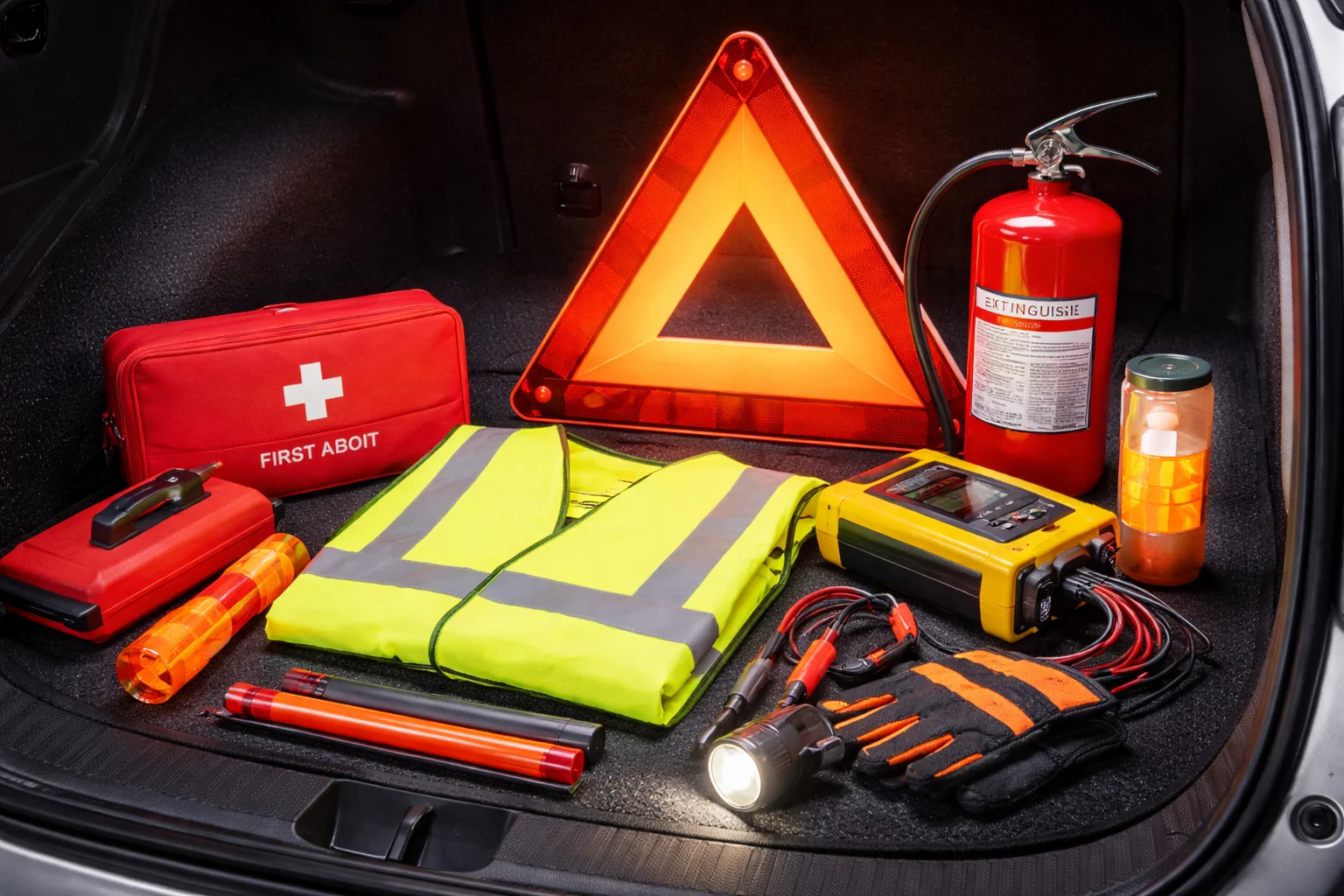
Road Safety Accessories Worth Keeping in Every Car
The single most cost-effective car safety accessory is still a tire pressure gauge — under $15, and the IIHS documents that proper tire inflation reduces blowout risk by roughly 80%. Beyond that, a prioritized list of five accessories delivers 90%+ of the marginal safety benefit: a lithium-ion jump starter (replaces jumper cables), a DOT-compliant first aid kit, a high-quality LED flashlight with hazard-flash mode, tire plug kit with 12V inflator, and a compact glass breaker and seatbelt cutter. Total investment: $140–$220. These cover the specific scenarios that produce the most NHTSA roadside-incident reports.
The five highest-impact accessories, in order
1. Lithium-ion jump starter ($50–$100)
A jump starter replaces the need for another vehicle and jumper cables. Modern compact units weigh under 2 pounds and start a V6 engine 15–20 times per charge. Unlike cables, they work when you are alone in a parking lot at night — the most common dead-battery scenario per AAA's 2024 roadside data (37% of all jump calls).
Recommended units with specific specs:
- NOCO Boost Plus GB40 ($99): 1,000A peak, up to 6L gasoline / 3L diesel
- Schumacher SL1611 ($79): 1,000A peak, built-in flashlight, USB-C output
- Audew 2000A ($70): larger capacity, handles up to 8L gasoline / 6L diesel
Charge the unit every 3 months. Lithium cells self-discharge 3–5% per month and lose substantial starting capacity when fully depleted for extended periods.
2. Compact tire inflator with plug kit ($30–$60)
Flat tires are the second-most-common roadside incident (33% of AAA calls). A plug kit with an integrated 12V inflator handles 70%+ of punctures without needing to change to a spare — enough to limp to a tire shop.
Proper plug kits include reamer, insertion tool, self-vulcanizing rubber strips (not just string plugs), and the 12V pump. Under $40 at any auto-parts store. Practice once in the driveway before needing it; the technique takes 5 minutes to learn.
3. First aid kit with trauma supplies ($35–$70)
A standard Red Cross kit covers minor cuts and bruises. A better investment for roadside emergencies is a DOT Class A kit or an IFAK (Individual First Aid Kit) with:
- CAT (Combat Application Tourniquet) or SOF-T tourniquet
- Israeli pressure bandage
- Trauma shears
- Chest seal for sucking chest wounds
- Space blanket for shock prevention
- Gloves, face shield
- Standard bandaging and antiseptic supplies
The MyMedic Recon and Mountain Man Medical IFAK are both at the $50–$80 range and represent a meaningful step up from generic first-aid kits for actual crash scenarios.
4. High-quality LED flashlight with hazard mode ($25–$50)
Every cellphone has a flashlight. A dedicated flashlight has three advantages: longer battery life, brighter output (500–1,000 lumens vs phone's 50–100), and a flashing hazard mode that makes you visible to passing traffic.
Specific picks:
- Fenix PD36 R ($89): rechargeable, 1,600 lumens, IP68 waterproof
- Olight Baton 4 ($60): compact, 1,300 lumens, magnetic base
- Streamlight ProTac 2L-X ($50): AA-powered (no charging required during storage), 500 lumens
5. Glass breaker and seatbelt cutter ($10–$25)
In water submersion or post-collision scenarios, tempered side glass must be broken to escape. NHTSA studies on submerged vehicle egress show that occupants with a glass breaker escape in 30–60 seconds versus 2–4 minutes for those without.
Spring-loaded center-punch breakers work more reliably than hammer-style in high-stress situations. Mount on the driver's visor or in the center console with hook-and-loop tape — out of sight but accessible with one hand. Combined glass-breaker-and-seatbelt-cutter tools at $12 cover both functions.
Second-tier accessories worth considering
- Dash camera ($60–$250): provides objective evidence in accidents. BlackVue, Viofo, and Thinkware produce reliable dual-channel (front + rear) units in the $150–$250 range that serve most insurance claim needs.
- Emergency radio with NOAA weather bands ($30–$60): useful for extended breakdowns in remote areas. Kaito Voyager and Eton FRX5-BT are well-reviewed.
- Reflective triangles or LED flares ($15–$40): DOT-required for some commercial vehicles; strongly recommended for all. LED flares last longer than traditional flares and are reusable.
- Tow strap ($20–$40): 20-foot recovery strap rated 20,000+ pounds. Useful if your vehicle becomes stuck but still operable.
Winter-specific additions
For drivers in snow belts, add:
- Tire chains or cable chains appropriate to your tire size ($60–$180)
- Small folding shovel ($30–$50)
- Bag of sand or kitty litter (under $10, for traction under stuck tires)
- Wool blanket or emergency mylar blankets
- Hand warmers (chemical, 10-pack $12)
- Extra winter gloves, hat, and boots stored in a zip-lock bag
What the data says about actual crash survivability
NHTSA crash survivability analysis consistently shows three factors drive crash outcomes more than any accessory:
- Seatbelt use (reduces fatal injury 50% for front-seat occupants)
- Vehicle age (newer vehicles with modern airbags, structural design, and AEB systems have roughly 56% lower fatality rates than pre-2000 vehicles at equivalent impact)
- Driver impairment and fatigue avoidance (drowsy driving causes an estimated 91,000 crashes per year)
No roadside kit replaces these. But after a crash has occurred, a tourniquet or glass breaker dramatically changes survival odds in the specific scenarios where they apply.
What NOT to buy
- “50-in-1” roadside kits at big-box stores: typically $30 for 50 cheap items, few of which work reliably. Better to buy 5–7 quality items separately.
- Emergency auto-escape “keychain” tools: the spring mechanism on cheap keychain glass breakers often fails on first use. Pay for a full-size Resqme or ResQmyTouch.
- Self-contained fire extinguishers under 2 lbs: car fires reach full-engulfment in roughly 2 minutes per NFPA data. Small extinguishers do not deliver enough suppressant to matter. If you want a car extinguisher, buy a 5-lb ABC unit.
- Aftermarket airbag-disable switches: altering airbag systems without documented medical necessity is illegal in most states and voids vehicle crash safety warranty.
Frequently asked questions
Do I need all these accessories, or is one kit enough?
The five core items cover 90%+ of common scenarios. Winter additions make sense in northern states. Second-tier additions like a dash camera have value but are not essential for safety — they are evidence-capture tools.
Where should I store these items in the car?
First aid kit, flashlight, glass breaker, and tourniquet in the center console or glove box (accessible from the driver's seat). Jump starter, tire plug kit, and inflator in the trunk or under the cargo area (not needed in-motion but needed in incidents). Reflective triangles and emergency blankets anywhere in the cargo area.
How often should I check the kit?
Every 3–6 months. Jump starters need recharging, first aid supplies expire, tire plug rubber deteriorates. Mark a calendar reminder. Replace expired items rather than trust them in an emergency.
Is AAA membership still worthwhile if I have these tools?
Yes, for the cases these tools cannot address: needing a tow beyond your ability to drive, mechanical failure not resolvable roadside, or incidents where you are injured. AAA Premier Service ($130–$170/year) includes 200-mile tows and significantly expanded reimbursements for car-rental emergencies.
Is a dashcam worth it for an average driver?
Yes. Insurance studies consistently show that drivers with dashcam footage resolve disputed claims in their favor roughly 85% of the time versus 50–60% without. Even if you never have an incident, the $150–$250 cost is justified by one avoided at-fault determination over typical ownership.